Case Study: Quick-Turn Hard Cases with Custom Foam for Sensitive Nuclear Defense Components
Case Study: Quick-Turn Hard Cases with Custom Foam for Sensitive Nuclear Defense Components
Executive Summary
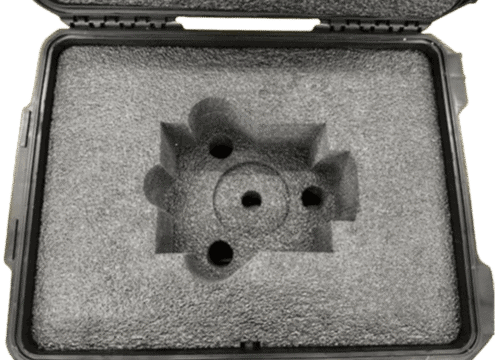
Due to the confidential nature of this program, some technical details, product views, and identifying information have been intentionally withheld, limited, or modified. The information and images included in this case study are presented in a way that preserves the accuracy of the packaging solution while protecting sensitive aspects of the underlying equipment.
When this customer found us online, they were frustrated with an existing supplier that was slow to respond, weak on communication, and repeatedly missed delivery deadlines. They needed a packaging partner who could move faster, communicate clearly, and handle highly sensitive equipment without scratches, dents, contamination, or inconsistent packing. We quoted the work the same day, delivered the first prototype in 5 days, and ultimately built a broader packaging system that included two hard-case pack-outs, a foam-lined shipping crate, and later a support case. Over a 3-month span, we replaced the previous supplier by delivering faster prototypes, shorter lead times, and consistent production without missing deadlines.
Project Snapshot

- Program type: Custom hard cases with foam plus a foam-lined wood crate
-
Customer type: Precision manufacturer serving nuclear defense programs
- Primary scope: Two hard-case pack-outs for sensitive components
-
Later scope: Foam-lined shipping crate and and additional support cases
-
Case platform: SKB 2015-10 for both main case SKUs
- Prototype method: Foam-only CNC-routed prototypes first
-
Production method: Waterjet-cut production foam for the two main case SKUs
- Timeline: 3 months
-
Production quantities: 144 units of the first primary case, 80 units of the second primary case, 38 foam-lined wood crates, and 2 support cases
-
Transport use cases: Internal transfer between processes, final customer transport, long-distance shipment, and repeated handling
-
Special requirements: Nitrogen-bagged equipment, desiccant protection, clean-case delivery, and consistent fit across production units
The Challenge
The customer’s previous supplier was creating problems in exactly the areas that mattered most. Lead times were slow, communication was poor, and deadlines were being missed. That was already difficult enough in a normal industrial program, but this customer was working with components used in nuclear defense applications where the packaging could not become the weak link.
They needed a supplier who would answer quickly, quote quickly, and actively help solve packaging issues rather than simply cut foam to a drawing. That meant being responsive in day-to-day communication, turning revisions quickly, visiting in person when needed, and helping determine the right prototype path instead of forcing the customer through a slower, more expensive process. The first impression mattered here: we quoted the work the same day and had the first foam-only prototype ready in 5 days. That speed helped establish confidence early in the program.
The Packaging Solution
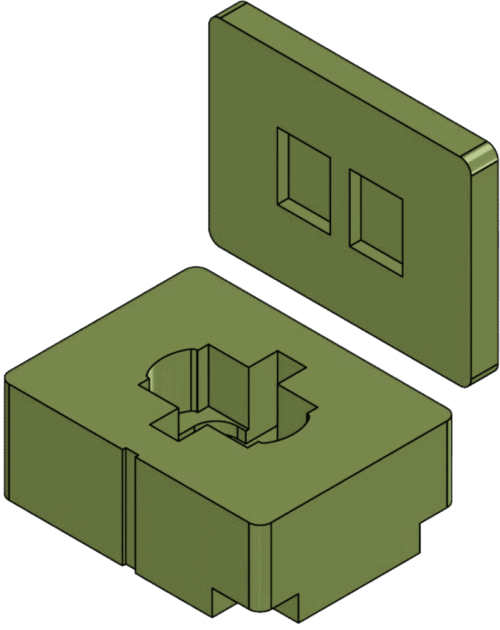
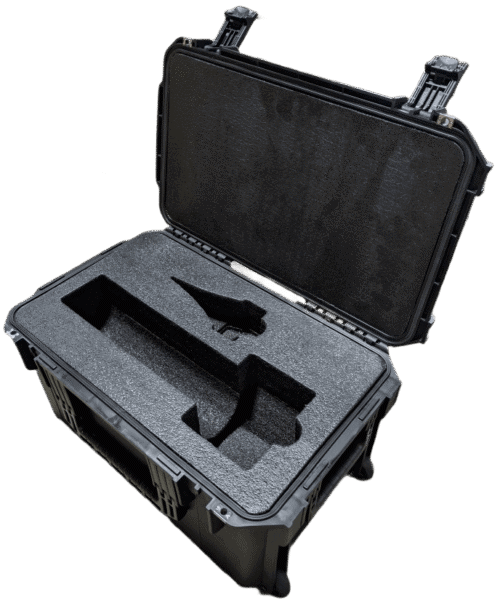
We built a packaging system around two primary hard-case SKUs, both using the SKB 2015-10 case because the customer had already standardized on that platform and already had a process for packing those cases into shipping crates. Rather than push them to change their broader system, we worked within the process they already had in place and focused on improving the fit, protection, speed, and reliability of the foam interiors.
Beyond the two main case pack-outs, we also produced a foam lining for a shipping crate used to transport the finished hard cases to the end customer. Each crate held four of each case, for a total of eight packed cases, and the foam lining added an extra layer of protection for long-distance shipping and rough military transport. Later, after the first phase of the program was successful, the customer moved two additional support cases over to us as well.
Turnaround and Collaboration
Speed and customer service were central to this project from the start. Our normal lead time for production orders was 2 weeks, compared with the previous supplier’s 4 weeks, and we never missed a deadline. But the biggest difference was not just the number of weeks on paper. It was how quickly the customer could get answers, updates, and real progress. We provided same-day replies, proactive communication, quick revision turns, in-person visits when needed, and guidance on how to solve fitment issues before they turned into production problems.
We also used a foam-only prototype-first approach, which was our recommendation. For sensitive equipment like this, a routed foam prototype is usually the fastest and most cost-effective way to confirm fitment before committing to the full case build. It lets the customer validate the geometry, handling, and clearances quickly, and if changes are needed, those changes can be made without wasting time or cost on a complete case assembly. In this program, that approach worked exactly as intended: the first prototype was delivered in 5 days, and each of the two primary cases went through two prototype iterations, including the first prototype.
Sensitive Equipment Constraints
These were not ordinary industrial parts. The two primary components had to be sealed in nitrogen-filled bags with desiccant before they were placed into the cases. That bagging process helped control moisture and reduce corrosion risk, but it also introduced a packaging complication: the bags were not always identical. Some were nearly skin-tight, while others held a little extra air and ballooned slightly at the top. The foam had to account for that variation without letting the parts move excessively inside the case. The cases also had to be kept extremely clean, so we cleaned and blew them out before delivery to make sure dust and debris were not introduced into the packing process.
Primary assembly case

The first primary unit was relatively compact but weighed about 50 pounds, which put significant pressure on the foam. The part had four large feet protruding from the bottom, along with a circle of smaller bolts around the middle. The previous supplier had not provided relief for those bolts, so over time they were rubbing against the foam and denting it. We solved that by adding four holes for the feet and a relief cut for the bolt circle, which distributed the pressure more evenly across the unit. That made it possible to use 2 lb PE foam, which the customer preferred because it was softer on the nitrogen bag and offered better vibration absorption. The relief geometry also made the foam less likely to wear out over time.
This unit also had a measurement device attached to the bottom that the previous supplier had not properly accounted for. In the earlier design, that feature could press against the bag and potentially create a puncture point, which could increase corrosion risk. We added a relief cut in the bottom foam so the device could sit safely within the foam without putting pressure on the bag. On the sides of the part, there were fittings that could vary in size from unit to unit. We cut the foam to fit the largest fitting size so the case would remain interchangeable, while still keeping the foam tight in the more consistent areas so the part stayed secure. The first prototype for this case was foam-only and CNC routed for speed; production units were waterjet cut, and all 144 production cases were kept to 1/16” tolerance.
Secondary assembly case
The second primary unit weighed about 30 pounds and had a different set of fitment challenges. To better accommodate the nitrogen bagging, we added an extra 1/8-inch of clearance around the unit compared with the earlier supplier’s design. That additional space solved the bag-clearance problem without compromising overall retention. The part also had sensitive fittings on the sides that the customer did not want touching the foam, so we left more clearance around those areas while keeping the fit tight in other areas to hold the unit securely in place. Like the first case, this part also had a circle of bolts on the bottom, and we added relief there so the foam supported the main body of the part rather than concentrating pressure on small protrusions.
This unit also had awkward geometry that made it difficult to lift straight up from above. To make repeated handling easier, we added slots that let the user get their hands deeper into the case and remove the part more safely. As with the first primary case, the first prototype was foam-only and CNC routed, then production was waterjet cut for speed and repeatability. We produced 80 of these cases, and all were consistent across the run, keeping 1/16” tolerance.
Foam-lined crate for final transport
Once the two primary hard-case pack-outs were established, the customer also needed added protection for final shipment. The cases were packed into a crate with internal dimensions of 55 x 35 x 27 inches, with four of each case loaded into each crate. The customer had already sourced the crates elsewhere by the time we began, so our role was to design and supply the internal foam lining rather than the crate itself. We lined the interior with 1.5-inch-thick 2 lb PE foam to provide an additional buffer against long-distance shipping stress and repeated handling. That extra precaution was especially important because these shipments had to travel long distances and withstand rough military transport conditions.
Production Consistency and Delivery Performance
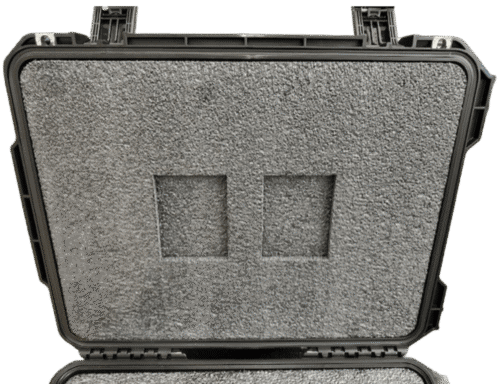
This project moved from prototype to production quickly, but the results were not rushed or inconsistent. The two main case SKUs were simple enough to shift from routed prototypes to waterjet-cut production foam, which helped keep production efficient while maintaining consistent geometry. Across 144 units of the first primary case and 80 units of the second, the production builds were consistent and repeatable. We never missed a deadline, and the packaging held up in the real-world environments it was designed for: transfer between internal processes, final transport to the customer, long-distance shipment, and repeated handling.
Just as importantly, there were no reports of equipment damage, no scratches, no dents, and no foam-related failures. That matters in any technical program, but especially in one tied to nuclear defense applications where the packaging has to support a controlled process rather than introduce new risk.
Prototype-to-Repeatability
A clear sign of the program’s success was the way the scope expanded over time. The customer did not just place one order and move on. After seeing the speed of the first prototype and the quality of the follow-through, they moved more work over to us. The project started with the two primary case SKUs, then expanded into the crate foam, and later into two additional support cases. By that point, the customer had transitioned the work fully to us.
The later support cases involved even heavier parts, over 80 pounds, with more complex 3D curves, slopes, and stepped foam geometry. Because of th
at complexity, we used CNC-routed 4 lb PE foam rather than waterjet cutting, since the parts were not bagged and the slightly rougher surface finish was not a concern. We only produced two each of these support cases, but they were within tolerance as well. More importantly, their addition showed the customer had enough confidence in our responsiveness, technical judgment, and delivery reliability to expand the relationship. The feedback we received reflected that: they appreciated not only the quick work, but also the quick, helpful customer service throughout the program.
Outcome
What began as a supplier-replacement project turned into a broader packaging program built on speed, clear communication, technical problem-solving, and consistent execution. In just 3 months, we quoted the work the same day, delivered a first foam prototype in 5 days, shortened lead times from 4 weeks to 2 weeks, and built a packaging system that supported sensitive nuclear defense components through prototype validation, production, and long-distance transport.
For this customer, the value was not just that the foam fit. It was that packaging stopped being a bottleneck. The cases arrived on time, the layouts solved issues the previous supplier had missed, the equipment stayed protected, and the customer had a supplier who responded quickly and helped guide the process instead of slowing it down.
Conclusion
When equipment is sensitive, schedules are tight, and previous suppliers have been unreliable, responsiveness matters just as much as the foam design itself. Good customer service in custom packaging is not only about answering emails quickly. It is about quoting fast, choosing the right prototype path, catching fitment risks early, communicating clearly through revisions, and delivering consistent production without missed deadlines.
For defense, nuclear, and other sensitive technical programs, that combination of speed, consultative support, and reliable hard-case packaging can make the difference between packaging being a delay and packaging becoming a solved part of the process.
About Vol Case
Volunteer Case & Container is the oldest custom crate and case manufacturer in the East TN area. Founded over 30 years ago, all of our protective packaging solutions are still designed and assembled at our facility in Oak Ridge, TN. We specialize in custom wood crates, ATA cases, wood or plastic containers, injection molded cases, and waterjet or CNC cut foam inserts. Our customers span a variety of industries including nuclear, government, aerospace, military, medical, R&D, and more. Our team has experience designing and building everything from huge wood crating for 70,000+ lbs machinery to small injection molded cases for key-sized objects. Whatever your needs, our team works on quick turnaround times to provide you with high quality protective packaging. Contact us today for a free quote.
Contact Us
Whether you need one wood crate or hundreds of ATA cases, we’d love the chance to earn your business. All of our designs and quotes are done for free without any purchase required. We are able to work off dimensions/CAD files that you provide to us or we can visit your facility to take measurements of the equipment.
(865) 481-3801
sales@volcase.com
328 Warehouse Rd. Oak Ridge, TN 37830