
Case Study: Organized Drone Transport Cases with Custom Foam for Field Kits
Case Study: Organized Drone Transport Cases with Custom Foam for Field Kits
Executive Summary
Due to the confidential nature of this program, some technical details, product views, and identifying information have been intentionally withheld, limited, or modified. The information and images included in this case study are presented in a way that preserves the accuracy of the packaging solution while protecting sensitive aspects of the underlying equipment.
As the customer expanded into the eastern United States, they needed more than a case and foam supplier close to their operations. They needed a packaging partner who could take a changing equipment list, engineering requirements, and end-user needs and turn them into an organized, field-usable drone transport case. Over roughly one year, we helped develop a three-SKU packaging program built around Pelican V600 cases for Atlas and Scout kits, plus a universal foam insert that could be used across configurations.
The program involved rapid revisions, fast digital updates, foam-first prototyping, and repeatable production. Over the course of the project, we managed 20 revisions and 8 physical prototypes before scaling into regular builds for kits used in shipping, storage, and field deployment. To date, we have produced 239 units across the three SKUs with no reports of broken units or foam failures.
Project Snapshot
- Program type: Drone transport cases and organized custom foam pack-outs
-
Equipment category: Drone / technical field kit
- Case used: Pelican V600
-
Foam used: CNC router cut 2 lb. PE
-
Design inputs: Physical parts and 3D models
- Revision volume: 20 revisions over roughly one year
-
Physical prototypes: 8
- Transport modes: Freight, vehicle, air, and manual carry
-
Number of components: 43 components across two cases
-
Production to date: 103 Atlas cases, 20 Scout cases, 116 universal foam inserts
-
Use cases: Customer shipment, storage, and field transport
- End users: Military and EMS
-
Outcome: Successful rapid prototyping over one year followed by production runs which continue today
The Challenge
A national drone company had expanded into the eastern U.S. and needed a supplier closer to its operations. But geography was only part of the issue. The larger gap was packaging design support. They did not just need foam cut to match parts. They needed someone who could help translate an equipment list, engineering requirements, and field-use needs into a practical packaging system.
The kit itself included a mix of components such as the drone, controllers, batteries, antennas, chargers, cords, manuals, and other accessories. That meant the packaging had to do several things at once: protect the kit in transit, keep every component organized, make small items easy to find, and still feel professional when opened in front of a customer.
The project was also moving quickly. The drones were 3D printed, which made it easier for the customer to improve the design, but it also meant packaging had to keep up with frequent changes. Supply-chain issues forced substitutions, customer feedback drove revisions, and ongoing design improvements changed what needed to fit inside the case. The packaging could not become the bottleneck.
Why This Kit was Difficult to Package
The customer wanted a compact packaging system while still fitting a large number of mixed components. Ultimately, we advised that the Pelican V600 was the smallest case possible. Some parts were large and structural. Others were small, fragile, or easy to forget, like antennas and small accessories. The layout had to keep all of those items visible, secure, and intuitive without turning the case into a cluttered or confusing pack-out.
The project also included three related SKUs: a primary Atlas case, a related Scout case, and a universal foam insert that could slot into either case. That insert also needed to support future flexibility, including the possibility of other packaging formats later. So this was not just one case layout. It was a small packaging system that needed to stay organized and consistent across multiple configurations.
A compact layout also created manufacturing challenges. In several areas, the foam walls became tall, thin, and long. Those kinds of walls are difficult to CNC route cleanly because the router bit can grab and tear them. So the design had to balance compactness, usability, durability, and manufacturability at the same time.
The Packaging Solution
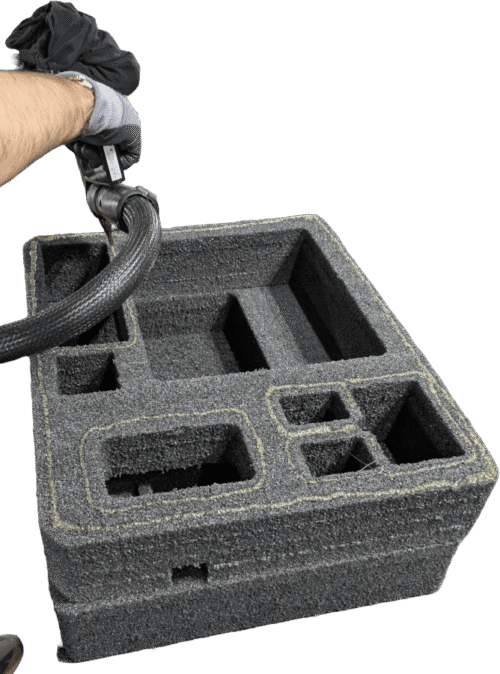
We built the program around three related SKUs. The primary Atlas configuration served as the main drone transport case. A related Scout configuration used the same Pelican V600 platform with a slightly different accessory-storage approach. A third SKU was a universal foam insert that could slot into either case and support future packaging flexibility without redesigning the core insert from scratch.
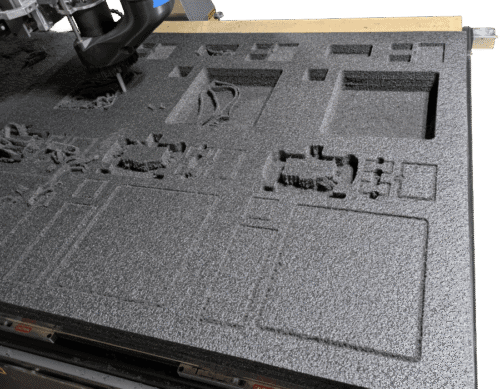
All foam was CNC routed from 2 lb PE. We worked from both physical parts and 3D models, which let us move quickly while still fitting varied shapes accurately. CNC routing also allowed us to minimize foam layers, resulting in a stronger, cleaner finished foam set than a heavily stacked, waterjet construction.
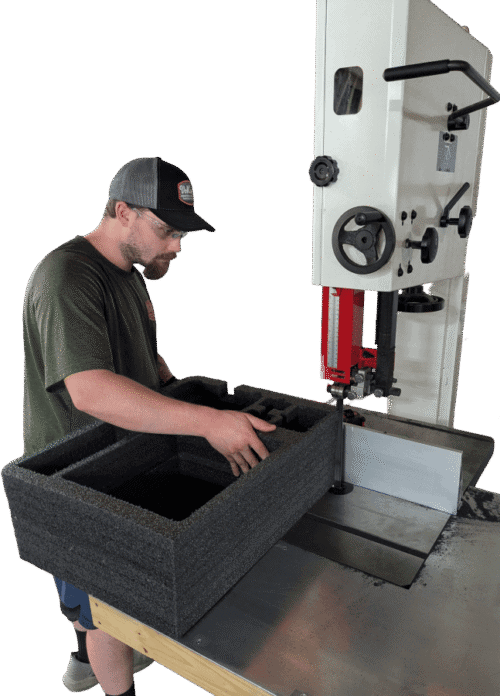
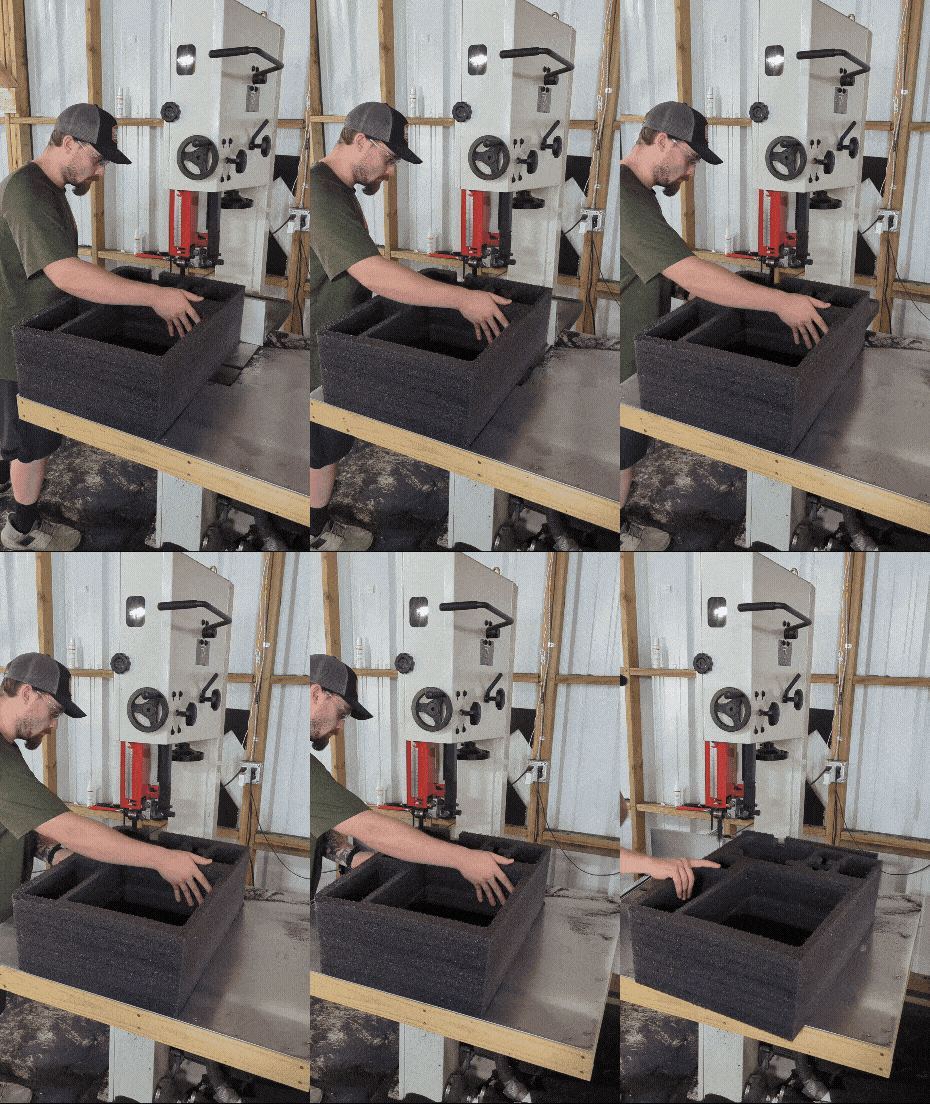
To solve the thin-wall machining problem created by the compact layout, we adjusted the manufacturing process. In key areas, we cut thicker walls on the foam during routing and then trimmed the excess on a bandsaw, which is gentler on thin walls than a router bit. That allowed us to keep the pack-out compact without sacrificing foam integrity or finish quality.
Layout and Usability Details
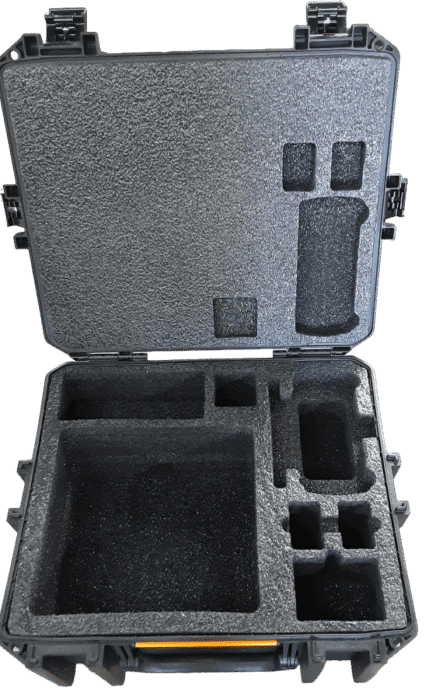
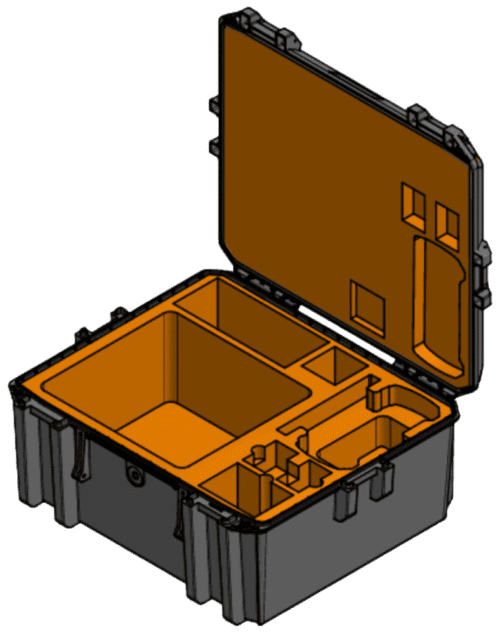
The layout was designed so that every component had a clear place. In the main case, the foam organized the drone, controllers, batteries, manuals, cords, chargers, antennas, and related accessories into a single, easy-to-read pack-out. Each pocket was cut to the exact profile of the part it held, making it immediately obvious where each item belonged and helping prevent missing or mixed-up components during packing and repacking.
One deliberate layout choice was how we handled small parts. In some foam sets, small parts get buried under larger components because it is possible to cut a small pocket inside a larger one. We chose not to do that here. Instead, small items were kept at the top of the foam so they remained visible and were less likely to be forgotten in the field. That was especially important for items like antennas and other small accessories.
We also recommended finger and hand slots where appropriate so components would be easier to grab and remove. Those kinds of details matter in repeated operational use. A good pack-out is not just about making everything fit. It also needs to make deployment, repacking, and inventory checks easier for the end user.
To maximize space and flexibility, the Scout case included an intentionally open accessory pocket rather than a fully foam-lined compartment. This area gave the customer extra room for durable miscellaneous items that could vary from case to case without forcing a full redesign. From a manufacturing standpoint, that feature created a challenge. Hard cases have a slight draft angle, and the foam normally needs a continuous exterior wall so it can be trimmed accurately on a bandsaw. Because this design had a partial wall, we stepped the external dimensions of the foam set out by 1/2 inch to create a stable temporary wall, then trimmed the excess away on the bandsaw. That approach allowed us to keep the flexible pocket while still maintaining clean geometry, manufacturability, and consistent finished quality.
The finished layout also supported a more professional presentation. These were not low-cost consumer products. The end customers were paying thousands or tens of thousands of dollars for these systems, often for government, EMS, or agency use. The case needed to look organized, intentional, and high-value when opened.
Field Usability and Transit Protection
These cases were designed for more than shelf storage. They needed to support shipment to customers, repeated loading and unloading, storage between uses, and movement between test sites or field locations. The layout had to remain practical over time, not just look good in a prototype review.
Exact-fit pockets, minimized foam layering, and stronger machining around thin wall areas all helped the kits hold up during transit and repeated handling. Because the kits included mixed component types such as batteries, controllers, antennas, electronics, and accessories, the pack-out needed to protect both the hardware and the organization of the kit.
To date, the packaging has performed well in shipment, storage, and field use, with no reports of broken units, no foam failures, and no known pattern of shipping-related issues.
Flexible Configurations and Future-Proofing
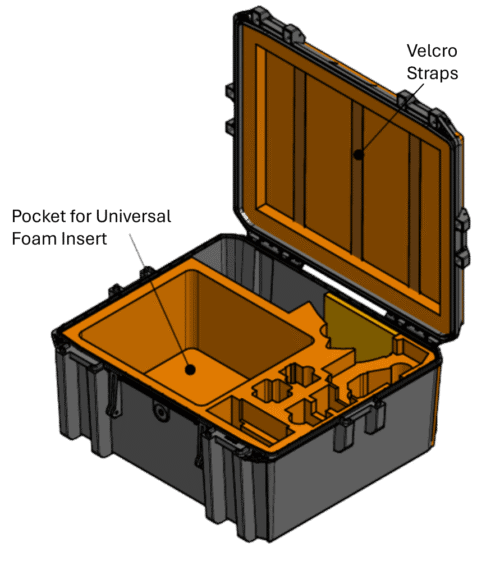
One of the most useful features in the system was the large flexible pocket in both cases. That area was designed to hold either the universal foam insert or a third-party softshell go-bag, depending on how the customer wanted to configure the kit. That gave them a more flexible “grab-and-go” option that would still work with the overall packaging system if they ever upgraded.
This flexibility was valuable for more than just one mission profile. It also made the packaging more future-proof. If the drone design changed or a customer needed a new insert configuration later, they could update the insert rather than replace the entire case-and-foam system.
The related Scout configuration also supported more flexible accessory storage through velcro lid straps and a more open miscellaneous area. Together, these features made the packaging system more adaptable across different accessory mixes, mission needs, and future SKUs. The same universal insert could even support a future corrugated box-based product without redesigning the core insert layout from scratch.
Rapid Revisions and Consultative Support
Speed was a major part of this program. Over roughly one year, we managed 20 revisions across the three SKUs. Not every change required a physical sample. Many digital-only revisions were turned around the same day or the next day, which let the customer confirm evolving changes before spending time and money on a prototype.
When physical samples were needed, those moved quickly too. In one instance, we turned around a prototype in 2 days from the time the design edits were needed to the completed product. Across the full program, we produced 8 physical prototypes.
Whenever possible, we started with foam-only prototypes. That approach let the customer validate fit, organization, and usability before paying for a full case-and-foam build. If the foam needed more tweaking, they had saved both time and cost. If the prototype was good, we could move directly into the completed case with very little downside.
This was also a consultative packaging effort, not just a manufacturing job. We helped choose the case platform, worked from parts and CAD, translated equipment and needs lists into practical layouts, recommended finger-slot placement, and guided decisions about where small parts should be located so they would be easier to see and less likely to be left behind.
That same responsiveness carried into production. On one order, the customer needed 20 Atlas cases and 20 universal foam inserts. We completed all 40 units in 8 business days, which was a full week ahead of the required deadline.
Outcome
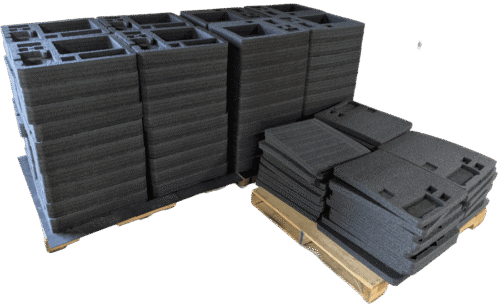
To date, the program has produced 103 Atlas cases, 20 Scout cases, and 116 universal foam inserts. What began as a fast-moving development project became a repeatable packaging program with multiple related SKUs.
Just as importantly, the revisions remained smooth over time. As the drone platform and accessories changed, the packaging was able to change with it without losing the underlying logic of the pack-out. The layouts stayed organized and repeatable across builds, which gave the customer a consistent product.
The end result was a packaging system that protected a mixed technical kit, presented it professionally, and made it easier for users to deploy and repack without missing parts.
Prototype-to-Repeatability
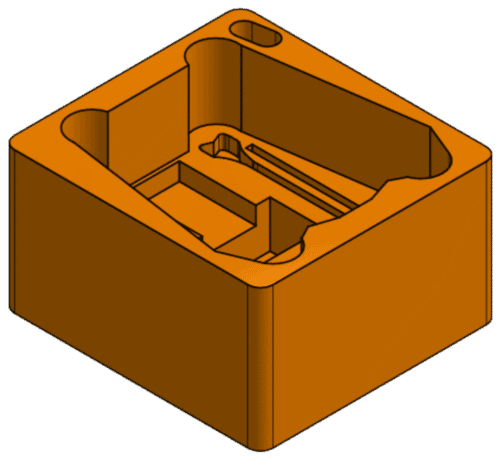
This project started with rapid design changes, frequent updates, and low-volume prototypes. Over time, it turned into a more repeatable set of SKUs that could be reproduced consistently across units.
Once the layouts were proven, the same pocket geometry and organization could be carried forward into regular builds. That consistency mattered not just for manufacturing, but for the end user as well. A repeatable pack-out means the same kit logic from case to case, which supports training, deployment, inventory checks, and customer confidence.
The universal insert also added long-term scalability. Instead of requiring a full packaging reset every time the drone or mission changed, the customer had a way to update the internal configuration while keeping the broader packaging system intact.
Conclusion
If you need a drone transport case or organized pack-out for a robot, comms, or other field-deployed technical kit, the same approach can support everything from a prototype needed next week to repeatable production runs over time. In programs like these, good packaging is not just about protecting the hardware. It is also about organization, speed, field usability, professional presentation, and the flexibility to support future kit changes without starting over.
About Vol Case
Volunteer Case & Container is the oldest custom crate and case manufacturer in the East TN area. Founded over 30 years ago, all of our protective packaging solutions are still designed and assembled at our facility in Oak Ridge, TN. We specialize in custom wood crates, ATA cases, wood or plastic containers, injection molded cases, and waterjet or CNC cut foam inserts. Our customers span a variety of industries including nuclear, government, aerospace, military, medical, R&D, and more. Our team has experience designing and building everything from huge wood crating for 70,000+ lbs machinery to small injection molded cases for key-sized objects. Whatever your needs, our team works on quick turnaround times to provide you with high quality protective packaging. Contact us today for a free quote.
Contact Us
Whether you need one wood crate or hundreds of ATA cases, we’d love the chance to earn your business. All of our designs and quotes are done for free without any purchase required. We are able to work off dimensions/CAD files that you provide to us or we can visit your facility to take measurements of the equipment.
(865) 481-3801
sales@volcase.com
328 Warehouse Rd. Oak Ridge, TN 37830