Case Study: Custom UAV Kit Transport Case & Organized Pack-Out
Case Study: Custom UAV Kit Transport Case & Organized Pack-Out
Executive Summary
Due to the confidential nature of this program, some technical details, product views, and identifying information have been intentionally withheld, limited, or modified. The information and images included in this case study are presented in a way that preserves the accuracy of the packaging solution while protecting sensitive aspects of the underlying equipment.
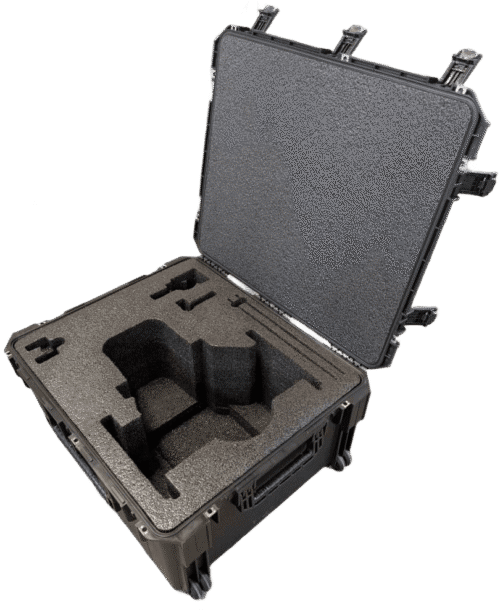
In 2026, a rapidly growing UAV startup contacted Vol Case because its existing supplier could not deliver two custom transport cases in time for an upcoming customer demo. This was not a simple one-item insert. Each case needed to function as an organized hard-case pack-out for a multi-component UAV kit, with dedicated positions for the UAV and support items, enough protection for shipping and field use, and a presentation quality that would hold up in front of customers. We received first contact on Tuesday afternoon and shipped the completed cases on Friday of the same week. The finished pack-out preserved the customer’s established layout, improved cut quality versus the incumbent supplier, and helped the team present the product more professionally than generic pick-and-pluck foam.
Project Snapshot
- Packaging type: Injection molded case with custom foam interior
-
Customer type: Rapidly growing UAV startup
- Program: Predator UAV (substitute name)
-
Year: 2026
-
Turnaround required: 3 days
- Quantity: 2 cases
-
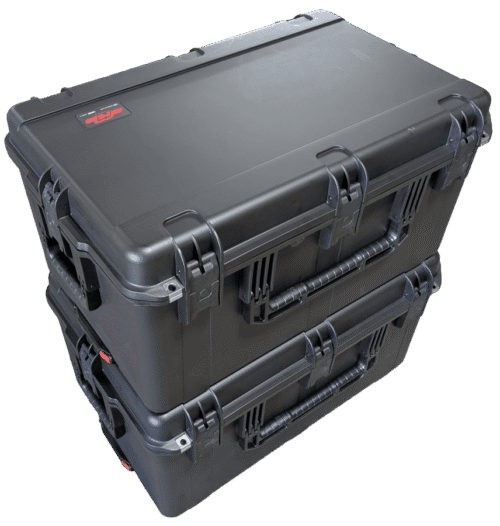
Case platform: SKB 3026-15
- Foam: CNC-cut 2 lb PE
-
Use case: Shipping, customer demos, and field testing
-
Outcome: Successful rapid prototype creation followed by future projects
The Challenge
The customer already had a selected case and an established foam layout. The problem was speed. Their current supplier was too slow to get cases completed in time, and the startup had a customer demo coming up the following week. They reached out to Vol Case after hearing about us from other UAV companies and needed a supplier that could move immediately without turning the project into a redesign exercise.
That created two constraints at once. First, the project had to move fast enough to support an end customer deadline. Second, the finished product still had to feel like the pack-out the customer already knew and trusted. Under that kind of schedule, changing the layout unnecessarily would have added risk. The better approach was to preserve the core design intent, execute it cleanly, and deliver an organized field transport case the team could start using right away.
Key Requirements
This project had to do several things at once. It needed to keep every component in a clearly defined location, support a multi-component kit rather than just the UAV itself, protect lightweight electronics and sensitive features during transport, and remain easy to load, unload, and repack during repeated use. It also had to arrive quickly enough for a near-term demo, and it had to present better than generic pick-and-pluck packaging once the case was opened in front of customers.
The Packaging Solution
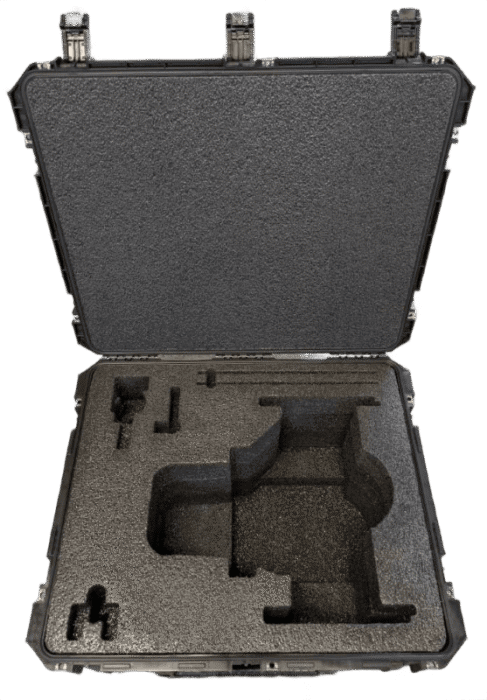
We built the solution around the customer’s existing platform: an SKB 3026-15 hard case fitted with custom, CNC-cut 2 lb polyethylene (PE) foam. We cut from the customer’s file with only small process-related adjustments on our end so that the finished insert would match the layout they were already used to. On a compressed schedule, we determined the safest path was to stick with what has worked well for them in the past and not do any redesign work.
Across both cases, the customer received the same repeatable layout. That gave the team consistency from one unit to the next and made the two cases function the same way in shipping, setup, and repacking.
Material selection was straightforward. The kit components were relatively lightweight, so there was no operational reason to move to a denser foam. For this application, 2 lb PE was the right choice because it was readily available on a rush timeline, cost-effective, and capable of providing the shock absorption needed for a lightweight UAV kit without adding unnecessary density or cost.
Organizing a Multi-Component UAV Kit
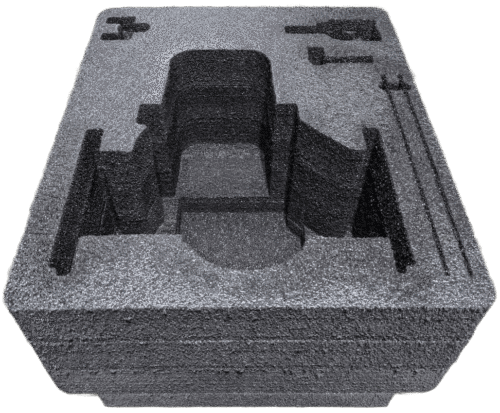
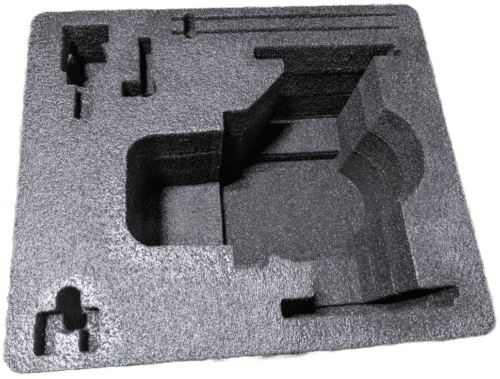
This case was designed as a real multi-component kit pack-out, not a single UAV cavity with loose accessories around it. Each case used seven dedicated positions across the UAV and support items, with separate locations for the UAV and key components including the controller, cables, hand tool, antenna, and charger.
This organization mattered for appearance, but also functionality. The defined layout helped prevent missing or mixed-up parts, sped up deployment, and made repacking more reliable at the end of a test session or demo. Instead of relying on operators to remember where accessories should go, the case itself becomes the checklist. When every component has a clear place, it is easier to see what is present, what is missing, and whether the kit is ready to move.
This was especially relevant here because the same case had to serve three roles. It needed to work as a storage case, as a field transport case moving between test locations, and as a customer-facing demo case. Those uses demand more than protection alone. They require an organized layout that can be opened, understood, and repacked quickly.
Fitment and Protection Details
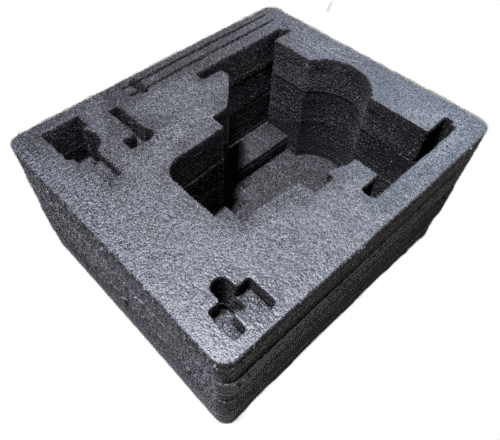
Several small design details helped make the insert more usable in practice. The foam included finger pulls and hand slots depending on the size and shape of the item. That made individual components easier to remove without digging at the foam or stressing nearby parts. For a kit that would be opened and closed repeatedly, those details improved daily usability.
We also incorporated relief cuts around sensitive connector pins. Relief around delicate protrusions helped ensure those features are not taking unnecessary load during insertion, removal, or transit or having any slight foam dust interfere with electronic ports.
The customer had already been using this general design, so the quality benchmark was clear: reproduce the pack-out accurately, but execute it better. According to the customer’s internal packaging engineer, our cut lines on the exact same design ended up cleaner than their incumbent supplier’s. In practical terms, that meant the foam followed the product profile more closely, resulting in better fitment, cleaner edges, and more controlled retention of the kit components. It also improved the visual finish of the pack-out, which mattered because these cases were being used in front of customers.
Turnaround and Collaboration
The turnaround was compressed from the start. First contact and the signed NDA happened on Tuesday afternoon. On Wednesday, we received the design files and rush ordered the empty cases. On Thursday, we cut the foam. On Friday, the empty cases arrived, we installed the foam, and shipped the completed cases.
That schedule mattered because the customer did not need a prototype at some later date. They needed finished, usable cases in hand for the next week. The value in this project was not just fast cutting. It was coordinating the case procurement, foam production, and final installation tightly enough to turn a Tuesday inquiry into a Friday shipment.
Just as important, the speed did not come from improvising the design. The customer wanted the same functional product they were already accustomed to using. Our role was to move quickly, make only the small manufacturing-related adjustments required on our side, and deliver a finished result that felt familiar and usable immediately.
Outcome
The cases went directly into customer-facing use and performed well. The customer’s internal packaging engineer specifically praised the communication, responsiveness, and speed of the project. They also reported that the foam from the demo performed very well and that their team was commended on the quality of the packaging. In their words, “Custom cut foam really set us apart from the pick and pluck a lot of our competitors were using”.
That last point matters for UAV programs. In many technical markets, the case is opened in front of customers, program managers, or evaluators before the product is ever powered on. A clean, organized pack-out signals control. It shows that the kit is complete, repeatable, and ready for use. In this case, the improved presentation was not cosmetic. It supported the customer’s credibility during a live demo.
The project also showed the practical value of better fitment. The customer noted that our cut lines were cleaner than the incumbent supplier’s on the same design because the foam followed the product profile more closely. That translated into a more precise fit, better part retention, and a more finished overall presentation.
From Rush Batch to Follow-On Work
This was only a two-case rush build, so it should be viewed as a small proof project rather than a production rollout. Even so, it demonstrated several capabilities that matter for UAV, robot, and communications kit style packaging: fast execution under deadline, organized multi-component layout, controlled fitment around mixed parts and accessories, and a pack-out that worked equally well for transit, field handling, and customer presentation.
It also did what a good rush project is supposed to do. It reduced immediate risk for the customer and established confidence for the next phase. The result has already led into a larger follow-on project.
Conclusion
For multi-component UAV kits, a useful case is not just one that protects the hardware. It has to organize the full kit, support repeated loading and unloading, protect delicate features where needed, and present the product professionally when the case is opened. In this project, Vol Case delivered that combination in a very compressed window: two repeatable hard-case pack-outs, built around an existing design, shipped in the same week, and used immediately for shipping, demos, and field testing.
For companies moving UAVs, robots, or other technical field kits between sites, that is often the real requirement. The case has to protect the equipment, but it also has to make the kit easier to use, easier to check, and easier to present.
About Vol Case
Volunteer Case & Container is the oldest custom crate and case manufacturer in the East TN area. Founded over 30 years ago, all of our protective packaging solutions are still designed and assembled at our facility in Oak Ridge, TN. We specialize in custom wood crates, ATA cases, wood or plastic containers, injection molded cases, and waterjet or CNC cut foam inserts. Our customers span a variety of industries including nuclear, government, aerospace, military, medical, R&D, and more. Our team has experience designing and building everything from huge wood crating for 70,000+ lbs machinery to small injection molded cases for key-sized objects. Whatever your needs, our team works on quick turnaround times to provide you with high quality protective packaging. Contact us today for a free quote.
Contact Us
Whether you need one wood crate or hundreds of ATA cases, we’d love the chance to earn your business. All of our designs and quotes are done for free without any purchase required. We are able to work off dimensions/CAD files that you provide to us or we can visit your facility to take measurements of the equipment.
(865) 481-3801
sales@volcase.com
328 Warehouse Rd. Oak Ridge, TN 37830