
Case Study: Repeatable LiDAR Kit Pack-Out with Custom Foam
Case Study: Repeatable LiDAR Kit Pack-Out with Custom Foam
Executive Summary
Due to the confidential nature of this program, some technical details, product views, and identifying information have been intentionally withheld, limited, or modified. The information and images included in this case study are presented in a way that preserves the accuracy of the packaging solution while protecting sensitive aspects of the underlying equipment.
A LiDAR technology startup rents equipment used to map governmental infrastructure. Each system is shipped to a customer, used for a period of time, returned, repacked, and sent to another location. The cases move by freight, vehicle, and air, and each kit may go through this cycle multiple times per year.
The customer had already purchased 40 Pelican 1690 cases with pick-and-pluck foam. That foam compressed, tore out, and lost its shape quickly. As the material wore down, it stopped supporting the main unit effectively and contributed to equipment damage. The existing layout also did not have enough organized storage for the required accessories, so the company had to ship a separate cardboard box containing loose supporting components.
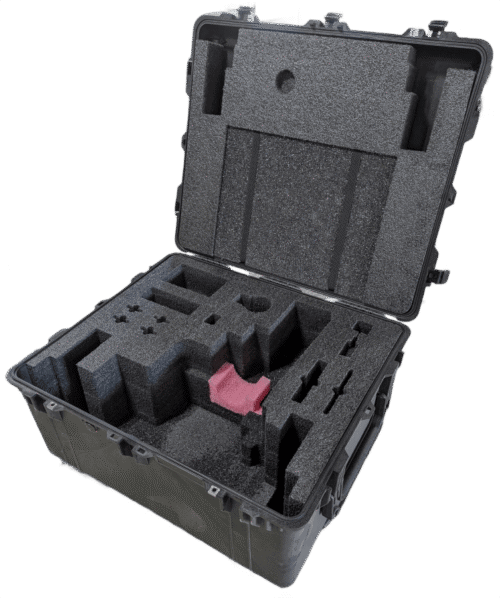
Vol Case developed a repeatable custom foam pack-out that organized the main LiDAR system and 19 additional components inside the existing Pelican 1690. The final layout holds 20 total components in 13 defined pockets, uses durable 1.7 lb polyethylene foam throughout the main pack-out, and incorporates a 3D-contoured 2 lb anti-static PE insert immediately around the LiDAR.
After three digital design rounds and two physical prototypes, the approved design moved into production. The first 10-unit batch was completed in roughly two weeks. The same layout will be reproduced across all 40 existing cases and carried forward into future complete case-and-foam assemblies supplied by Vol Case.
The objective was not simply to replace worn foam. It was to establish one controlled packaging system that could be repeated across an existing rental fleet and reproduced again for future units.
Project Snapshot
- Program type: Repeatable custom foam retrofit and future complete case builds
-
Equipment category: Mobile LiDAR systems
- Project stage: Internal concept to full production
-
Quantity of cases: 40
- Transport modes: Freight, vehicle, and air
-
Number of components: 20 components organized into 13 pockets
-
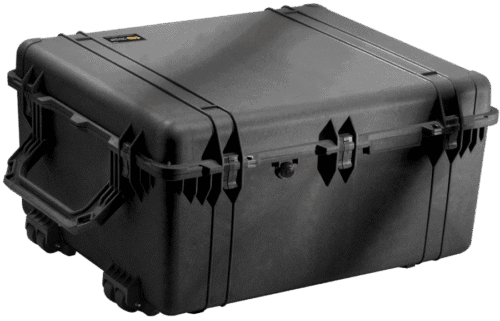
Case used: Pelican 1690 Protector case
- Foam used: 1.7 lb PE & 2 lb pink anti-static PE with a 3D-contoured pocket
-
Lid retention: Two 1″ wide elastic nylon straps
-
Manufacturing tolerance: Within 1/16 inch
-
Production method: CNC-routed
- Outcome: Successful prototyping followed by repeated orders which continue today
The Challenge
The original packaging had been built around pick-and-pluck foam. That gave the customer a quick way to place the main unit in a case, but it did not provide the durability, organization, or repeatability required for a rental fleet.
The foam began compressing and tearing out after repeated use. Once sections of the foam lost their shape, the main unit no longer received the intended support. The customer reported damage to the primary system as the packaging wore down.
The original arrangement also treated the Pelican case primarily as storage for the large main unit. The accessories required to operate and deploy the system did not have clearly defined positions within the case. Items such as an iPad, iPad mount, external hard drives, cables, chargers, ratchet straps, magnets, stickers, and literature had to be handled separately.
Because those accessories did not fit into an organized pack-out, the company shipped a cardboard box alongside the hard case. That created several operational problems:
- Packing and unpacking were not intuitive because components did not have fixed locations.
-
Accessories could become mixed together inside the cardboard box.
- Checking whether a returned kit was complete was difficult.
-
The system required two packages rather than one integrated case.
- The presentation was not consistent with the value and technical nature of the equipment.
These problems repeated every time the rental equipment returned and was prepared for another customer.
The case platform itself was also fixed. The customer had already invested in 40 Pelican 1690 cases, so changing to a larger case would have made the existing inventory unusable. The main LiDAR system already occupied most of the available space inside the 1690, but the new pack-out still needed to accommodate 19 additional components.
The challenge was therefore to create a durable, organized, and repeatable technical kit without increasing the case size.
Key Requirements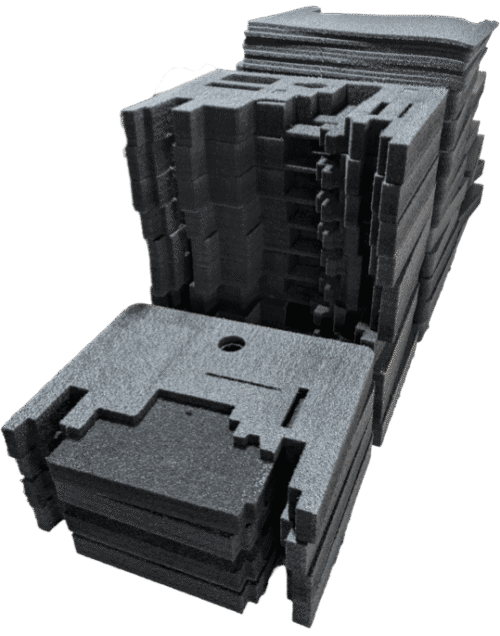
The new packaging system needed to meet several requirements at the same time:
- Preserve the customer’s 40 existing Pelican 1690 cases.
-
Fit the main LiDAR system and all 19 supporting components into one case.
- Give every component a defined and consistent storage location.
-
Replace the rapidly degrading pick-and-pluck foam with more durable PE foam.
- Provide anti-static foam immediately around the LiDAR.
-
Support repeated shipment by freight, vehicle, and air.
-
Make packing, unpacking, and completeness checks faster and more intuitive.
- Improve the presentation when the case was opened by a rental customer.
-
Allow the customer to install the completed foam assemblies without shipping all 40 cases to Vol Case.
-
Maintain the same approved layout across the existing fleet and future systems.
Since Vol Case would not be present during final installation of the first 40 foam sets, the assemblies also needed to fit the cases correctly without requiring case modifications or onsite foam adjustments.
The Packaging Solution
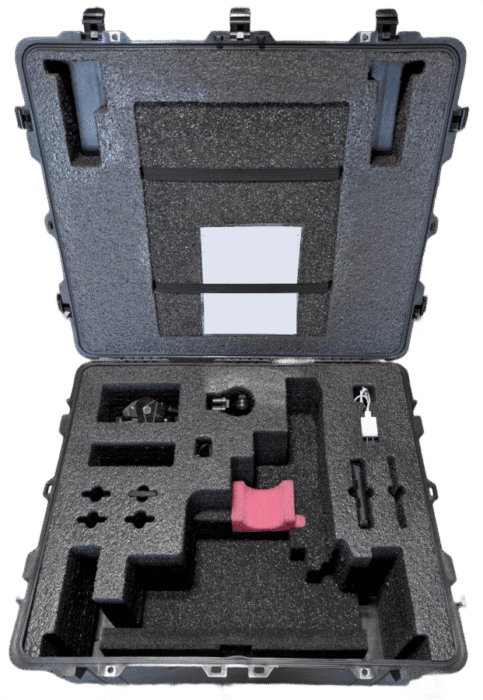
Vol Case designed the new pack-out around the customer’s existing Pelican 1690 platform. The main base and lid assemblies were manufactured from black 1.7 lb PE foam, with a separate 2 lb pink anti-static PE insert used around the LiDAR.
The finished layout organizes 20 components into 13 defined pockets. Not every physical item required its own separate cavity. In several areas, related or identical components were intentionally grouped into a shared pocket to use the available volume more efficiently.
The resulting design operates as one integrated kit. The main unit, electronics, mounting hardware, cables, straps, chargers, literature, and other accessories all travel inside the same hard case rather than being divided between a Pelican case and a loose cardboard box.
Each item has an established position and orientation. This makes the pack-out easier to understand and gives the customer one layout that can be repeated across the full rental fleet.
Using Case Depth and Lid Space to Fit the Full Kit
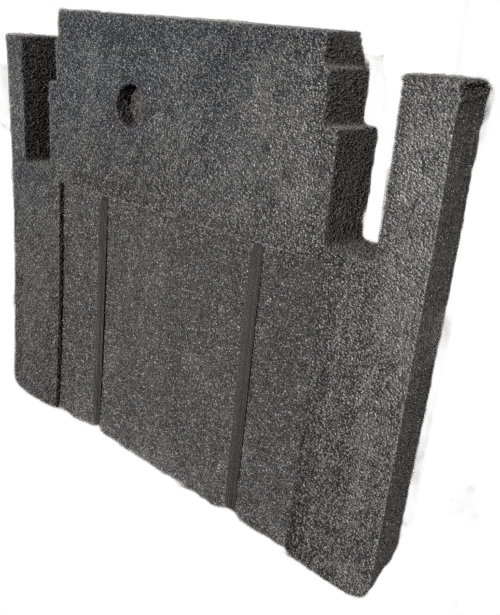
The main LiDAR unit barely fit within the Pelican 1690 before the custom foam was added. Fitting another 19 components required using more than the visible horizontal footprint of the base.
One approach was to use pocket depth. For example, the kit included three ratchet straps. Creating three separate side-by-side pockets would have consumed too much space. Instead, Vol Case created one deeper pocket that allows the straps to be stacked vertically. This reduced the footprint required for the straps while still giving them a defined location.
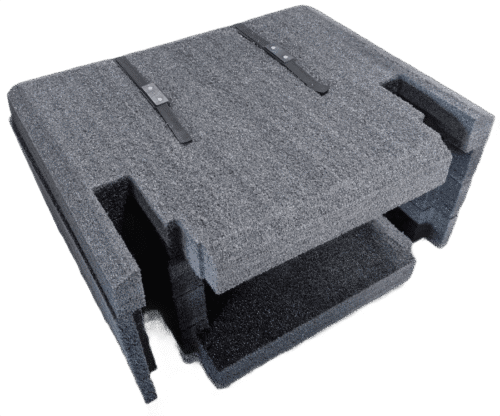
The case lid provided another usable storage area. Large but lightweight materials, including literature, were moved into the lid and retained with elastic strapping. This preserved base space for the main system and denser accessories while keeping the literature organized and accessible.
The lid storage was not treated as an unrelated add-on. Its placement, pocket orientation, elastic direction, and clearance from the main unit were all developed as part of the complete pack-out.
Together, the use of deeper pockets and controlled lid storage allowed the full 20-component kit to fit within the existing case platform.
Fixed Locations for Packing, Repacking, and Inventory Checks
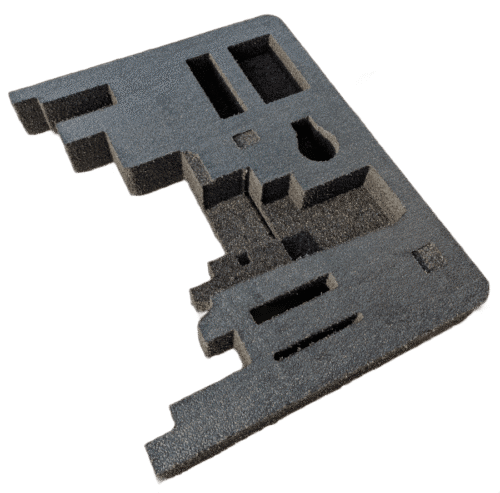
The previous packaging did not provide clear instructions for where accessories belonged. When the system returned from a rental, the person repacking it had to organize loose items inside a cardboard box without a stable visual reference.
The custom foam layout gives each component a defined position. Even where a pocket holds multiple related items, the expected contents and quantity are controlled by the pocket’s size and geometry.
This makes several parts of the rental process easier:
- The team can follow the same packing method each time a system is prepared for shipment.
-
Returned accessories are less likely to be placed in an arbitrary location.
- Missing or misplaced components are easier to identify.
-
The next user receives the same organized layout regardless of which physical kit is shipped.
- The case presents the equipment as one complete technical system rather than a collection of loose hardware.
The layout also improves repacking after use. Instead of requiring the end user or rental team to decide where each item should fit, the foam communicates the intended position through the shape and location of each pocket.
That consistency matters for equipment that is opened, used, returned, and prepared for another customer multiple times per year.
3D Anti-Static Foam Protection for the LiDAR
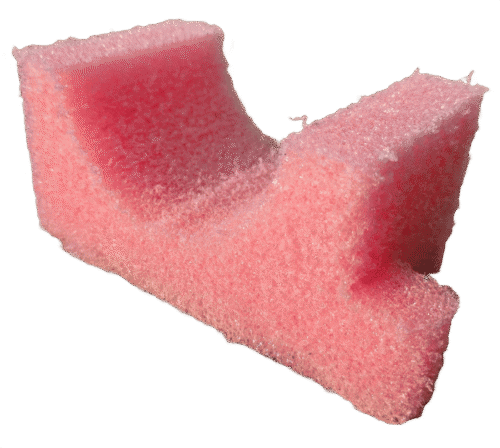
The LiDAR required a different material and pocket geometry than the rest of the kit.
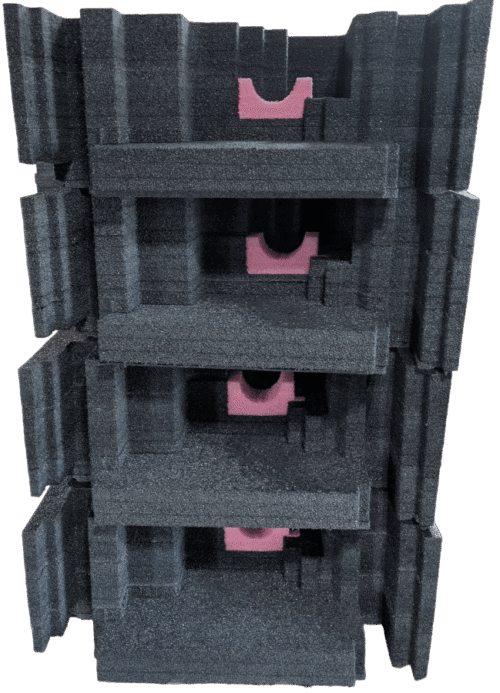
Most of the pack-out uses black 1.7 lb PE foam. Immediately around the LiDAR, Vol Case incorporated a separate 2 lb pink anti-static PE insert. This kept the specialized material focused on the sensitive component rather than unnecessarily building the entire foam set from anti-static foam.
The LiDAR also has a rounded profile. Placing it on a flat foam surface would not provide support that followed the component’s shape. Instead, the anti-static insert was CNC machined with a 3D-contoured pocket that follows the LiDAR geometry.
This allows the round LiDAR assembly to rest within a shaped cradle rather than against a flat piece of foam.
The position and orientation of the anti-static insert were important. During the initial design review, it was clear that a simple insert could potentially be installed in the wrong position during production.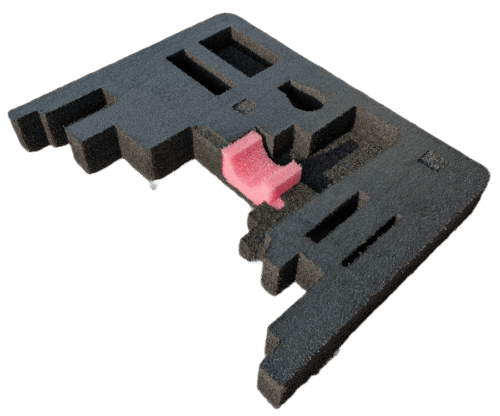
To prevent that, Vol Case added an asymmetrical protrusion to one side of the pink insert. A matching notch was cut into the surrounding black foam. The insert can only seat properly when the protrusion and notch are aligned.
This created a simple physical assembly control. The correct position is visually clear, and the insert cannot be installed in the incorrect position while still fitting the surrounding foam.
That feature supports repeatability at the manufacturing level. Every foam set receives the same anti-static insert in the same position rather than relying on an assembler to judge the location manually.
Prototype Fitment and Design Refinement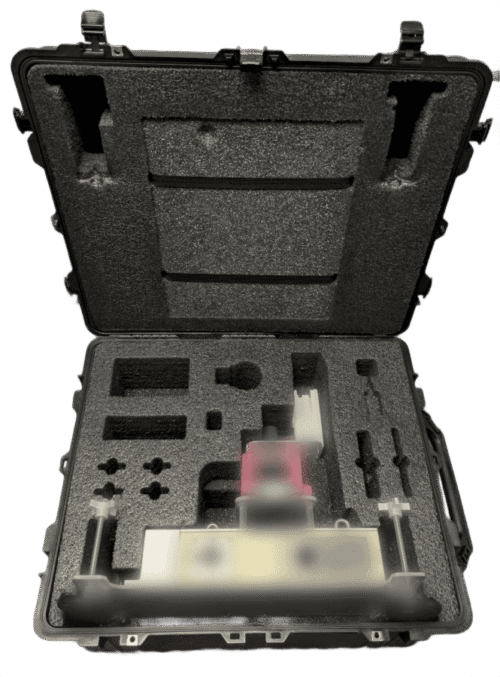
Vol Case responded to the customer’s initial inquiry within an hour, gathered the basic packaging requirements, and signed the required NDA.
After the customer provided a 3D model of the equipment, Vol Case completed the first digital design within three days. The project went through three digital design rounds as components were added and the layout was refined. The digital model was finalized approximately one week after the initial files were received.
The first physical prototype was completed and shipped six days after the digital design was approved. After receiving a photo of the manufactured prototype, the customer responded:
“This is so sick. I am so pumped. This is going to really change the user experience! Thank you and I can’t wait to see it!”
The first physical test fit later identified an issue that could not be seen in the supplied model. Several knobs on the main unit had not been included in the 3D data. When the actual equipment was placed in the case, those knobs extended into the lid area and compressed the lid foam.
The customer sent Vol Case an equipped case so the full system could be evaluated directly. Within two days of receiving it, Vol Case revised the design, cut a second physical prototype, and tested the fit against the actual equipment.
Relief pockets were added to the lid foam so the knobs could extend into the lid area without pushing against excess material. This made the case easier to close and removed unnecessary compression between the main system and the lid foam.
The knob locations also affected the literature storage. The initial literature pocket was aligned vertically in the lid, but that placed part of the pocket over one of the required relief areas. The literature pocket was rotated 90 degrees so the two features no longer overlapped.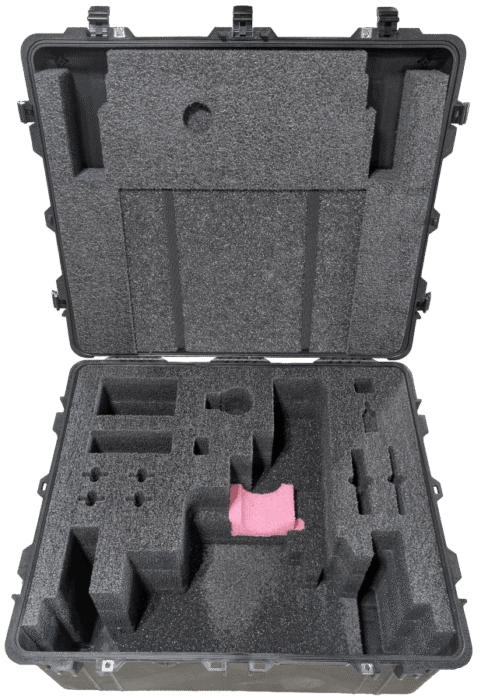
The elastic retention direction was refined as well. The first prototype placed the straps horizontally when the case was open. That orientation put the straps vertically while the case was being rolled, which was originally expected to reduce movement during transport.
Testing showed that the literature remained controlled once the case was closed. It was more likely to slip while the lid was open. The straps were therefore rotated 90 degrees so they ran vertically when the case was open. When the literature pocket was later rotated to avoid the knob relief, the straps remained in the revised vertical orientation.
Because Vol Case now had the actual case and equipment in-house, the second prototype could be test-fitted directly. Fitment photos were sent to the customer, the revised design was approved, and the equipped case was shipped back the following day.
The changes between the first and second physical prototypes were relatively small, but they mattered in repeated use. The final case was easier to close, the main unit no longer compressed the lid foam, and the literature was better retained while the case was open.
A Customer-Installed Retrofit for 40 Existing Cases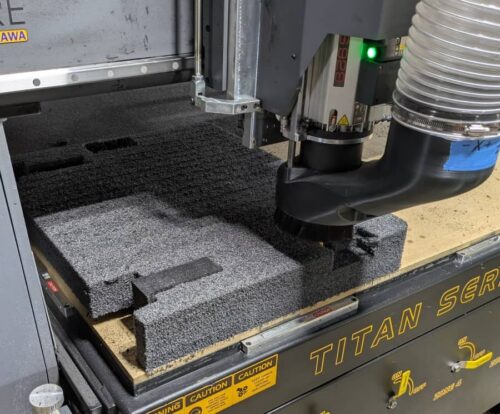
The initial production phase is structured as a foam-only retrofit because the customer already owns 40 Pelican 1690 cases.
Shipping all 40 empty cases to Vol Case and then shipping them back would add substantial freight cost without much difference in the final product. Instead, Vol Case keeps a Pelican 1690 in-house as the fitment reference for production.
Each foam set is fully assembled before shipment. Vol Case:
- Cuts the layers from the approved CAD and CAM files.
-
Glues the foam layers together using the established assembly method.
- Installs and secures the 3D-contoured anti-static insert.
-
Installs the elastic lid-retention system.
-
Trims the foam to fit the Pelican 1690.
- Inspects the completed assembly before shipment.
The finished foam is manufactured within 1/16 inch and checked in the reference case. The customer does not need to build the layered foam set, position the anti-static insert, or assemble the elastic retention system.
The customer’s remaining step is to bond the completed base and lid foam assemblies into its existing cases using 3M spray adhesive. This allows the existing fleet to be upgraded without transporting 40 cases back and forth or requiring specialized adhesive equipment at the customer’s facility.
The retrofit method also required the foam to be right before it left Vol Case. Since Vol Case would not be present during final installation, the case fit, lid clearance, layer alignment, and internal assembly could not depend on onsite adjustments.
Production Repeatability and Quality Control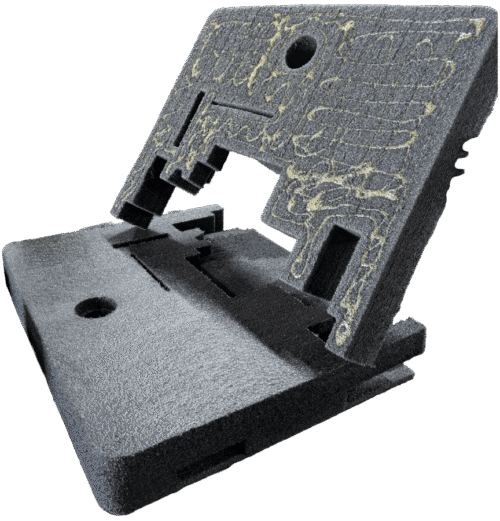
Once the second prototype was approved, that design became the production standard for the program.
All 40 retrofit foam sets use:
- The same CAD geometry
-
The same CAM and machine files
- The same foam types and densities
-
The same pocket locations
- The same anti-static insert geometry
-
The same assembly techniques
-
The same production instructions
- The same fitment and inspection process
The goal is not to produce 40 foam sets that are generally similar. It is to reproduce one approved pack-out across 40 existing cases.
The foam sets are being ordered and manufactured in batches of 10. The first 10-unit production batch was completed in roughly two weeks and shipped to the customer immediately afterward.
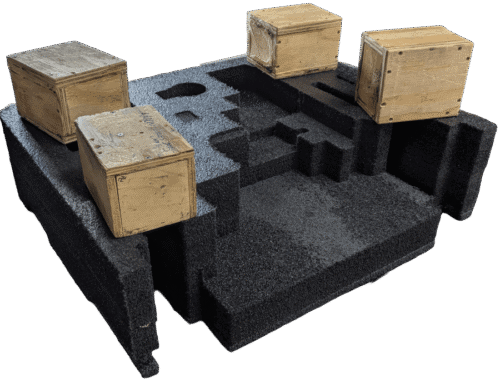
Producing in smaller batches allows the customer to convert the existing case fleet over time without changing the underlying packaging standard. Whether a foam set is produced in the first batch or a later batch, it is cut from the same controlled digital design and assembled using the same process.
The same production information will also be used after the initial 40 cases are converted. For future systems, Vol Case will supply the Pelican 1690 and install the same approved foam set in-house.
This creates continuity between the current retrofit phase and future complete case builds. The customer does not need one layout for its existing cases and another for new systems. The same pack-out can be carried forward
Outcome
The completed design turns what had been a case plus a loose accessory box into one organized 20-component technical kit.
The main LiDAR unit and its supporting equipment now travel together inside one Pelican 1690. The pack-out includes 13 defined pockets, purpose-built lid storage, a 3D-contoured anti-static LiDAR cradle, and fixed locations for the accessories needed to deploy the system.
Compared with the previous arrangement, the approved design provides several verified improvements:
- The case closes without the main unit pressing unnecessarily into the lid foam.
-
Literature and other lightweight lid materials are more securely retained.
- The accessories no longer require a separate cardboard box.
-
Packing and repacking follow one consistent layout.
- Completeness checks are easier because components have defined locations.
-
The kit has a cleaner and more professional presentation when opened.
- The same packaging method can be reproduced across the rental fleet.
The customer approved the second physical prototype and moved into production in 10-unit batches. The first production batch has been completed and shipped, and the same design is planned for all 40 existing cases.
The decision to expand one approved prototype into a 40-unit replacement program is the clearest evidence of the design’s fit, organization, and usability at this stage of the rollout.
Prototype-to-Repeatability
This project started with one digital model and one existing case platform. It developed through three digital design rounds and two physical prototypes before becoming a controlled production design.
The approved prototype now serves as the reference for:
- 40 identical foam retrofits
-
Multiple 10-unit production batches
- Consistent component locations across the existing rental fleet
-
Future replacement foam sets
- Future complete Pelican 1690 case-and-foam assemblies
That progression is what separates a repeatable packaging system from a one-off custom insert.
A one-off insert only needs to fit the equipment in front of it. A repeatable pack-out needs defined geometry, controlled materials, stable component locations, documented assembly methods, fit verification, and production data that can be used again without redesigning the case.
For this rental program, consistency also has an operational benefit. Each case is designed to open with the same components in the same locations. The team does not need to establish a new packing method for every unit, and future builds do not require the packaging layout to be recreated from the beginning.
The first approved unit therefore solves both the immediate packaging problem and the longer-term need for identical builds across an expanding fleet.
Conclusion 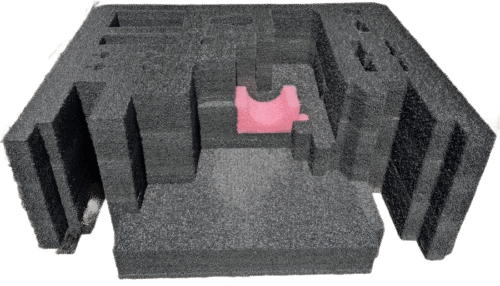
Deployable technical kit packaging requires more than cutting cavities around a group of components. The case has to protect the equipment during transport, organize the complete system, make repeated packing and unpacking practical, and preserve the same layout from one unit to the next.
In this project, a mobile LiDAR company needed to replace rapidly degrading pick-and-pluck foam without discarding 40 existing cases. Vol Case converted the Pelican 1690 into a standardized 20-component pack-out, validated the layout through physical testing, and established a production process that can reproduce the same design across the current fleet and future units.
The same approach can support other repeatedly deployed sensor systems, robotics kits, UAV equipment, communications systems, test equipment, and multi-component technical kits. When the packaging is expected to move from one prototype to many identical builds, the case, foam, component locations, assembly process, and production controls all need to be treated as one system.
About Vol Case
Volunteer Case & Container is the oldest custom crate and case manufacturer in the East TN area. Founded over 30 years ago, all of our protective packaging solutions are still designed and assembled at our facility in Oak Ridge, TN. We specialize in custom wood crates, ATA cases, wood or plastic containers, injection molded cases, and waterjet or CNC cut foam inserts. Our customers span a variety of industries including nuclear, government, aerospace, military, medical, R&D, and more. Our team has experience designing and building everything from huge wood crating for 70,000+ lbs machinery to small injection molded cases for key-sized objects. Whatever your needs, our team works on quick turnaround times to provide you with high quality protective packaging. Contact us today for a free quote.
Contact Us
Whether you need one wood crate or hundreds of ATA cases, we’d love the chance to earn your business. All of our designs and quotes are done for free without any purchase required. We are able to work off dimensions/CAD files that you provide to us or we can visit your facility to take measurements of the equipment.
(865) 481-3801
sales@volcase.com
328 Warehouse Rd. Oak Ridge, TN 37830