Custom Crates and Large Transport Packaging
Custom Crating for Large Equipment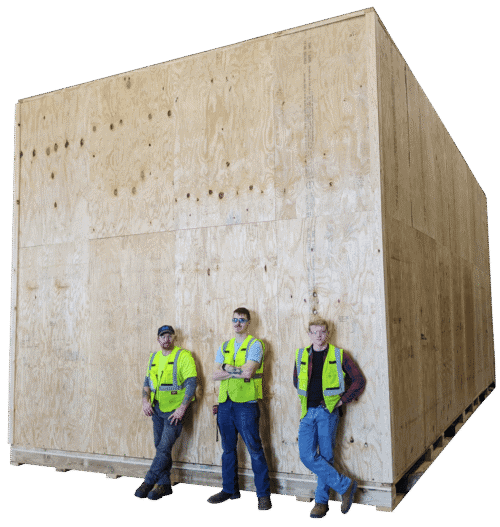
When a system is too large for a standard hard case or corrugated box, the real challenge is not just building a box around it. The challenge is designing secure support during transit so the equipment stays stable, protected, and practical to handle from pickup through delivery.
We design custom crates for large equipment or prototypes and engineered transport packaging for oversized technical equipment with non-standard dimensions, awkward geometry, delicate surfaces, and exposed features. Whether the system is a large robotic assembly, aircraft prototype, water purification system, or other oversized system, we design the package around the equipment, the transport modes, and handling methods.
That means defined support points, restraint design that prevents shifting, and protection for delicate surfaces and protrusions. For equipment that is too large for standard packaging, we provide full transport-ready solutions built for shipment, loading, unloading, and repeat use when multiple builds are involved.
When Standard Packaging Isn’t Enough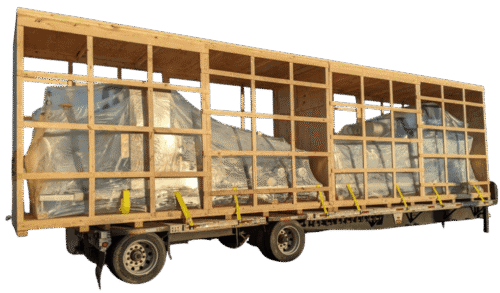
Standard packaging works well for compact equipment with regular dimensions and predictable support surfaces. They are often the wrong solution for large prototypes and oversized technical systems.
Standard packaging stops being practical when the equipment has:
-
Non-standard dimensions
- Delicate finishes or sensitive contact areas
-
Awkward geometry or an unstable resting surface
- Protrusions, antennas, booms, masts, or exposed structures
-
Support requirements that must follow specific structural load paths
-
A size or handling profile that makes a small-format case unrealistic
In those situations, the goal is not just containment. The goal is engineered oversized equipment packaging that keeps the system stable during shipment and prevents stress concentration, cosmetic damage, or shifting in transit.
Depending on the equipment and route, the solution may be a custom crate or large transport case. The key is that the support method is designed around the system’s geometry, structural hard points, handling method, and shipping environment.
Best Fit For
 Large aerospace systems
Airframes, ground systems, and integrated payload assemblies that are too large for standard cases and may include delicate surfaces, exposed antennas, landing gear, or irregular support geometry. Prototype aircraft components, fuselage sections, aero structures, test fixtures, and support equipment that need engineered support points and shipment stability.
Robotic systems
Robots and unmanned systems with arms, masts, sensor heads, cables, and appendages that create awkward geometry and require controlled restraint during transit. This can include anything from the primary FANUC arm to all the accessories such as barriers, light gate sensors, conveyor belts, and more.
Industrial machinery
Not only is industrial machinery typically large, but also very heavy. This makes a custom crate a no brainer. Equipment like injection molders, water purification systems, CNCs, and dies are common in manufacturing environments and require specialty crate packaging to handle the weight.
Multi-component assemblies
Manufacturing equipment is rarely a standalone piece of equipment. Along with the main unit, there is often piping/tubing, material loading tools, hoppers, control panels, temperature regulators, conveying systems, and more to support the main system. We frequently see all these items shipped at the same time and combined into a minimal amount of crates.
Example Applications
Unfortunately, there are several products we aren’t allowed to display due to the confidential nature of them. However, here are some recent projects that we are able to highlight:
Closing Production Line at Auto Manufacturer
Challenge:
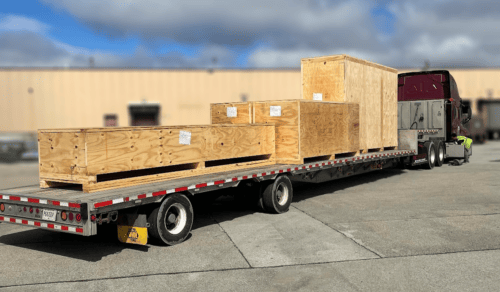
A large auto manufacturer was shutting down a large line of equipment to make way for new, electric vehicle parts manufacturing. All the existing machines were being shipped to Asia. This meant that in addition to securing and crating every machine, they also needed export-certified lumber and waterproof barrier bagging with desiccant to resist the moist, salty air during boat transit.
Solution:
Over the course of 8 weeks, we crated 120 pieces of equipment. There were 30 unique crate sizes that were all individually designed and a total of 58 crates built which weighed a combined 236,000 lbs. Most crates had more than one piece of equipment inside to improve efficiency in crating, handling, and shipping cost. All equipment was tagged with a specific number and the crates were serialized. This allowed us to give the customer a list of all the crates and their contents for clear exporting and unpacking.
Most importantly, when the project was complete, we had finished on-time, 3% under budget, and with no damage or issues reported with packaging or transport.
65,000 lbs. Equipment Crating
Challenge:
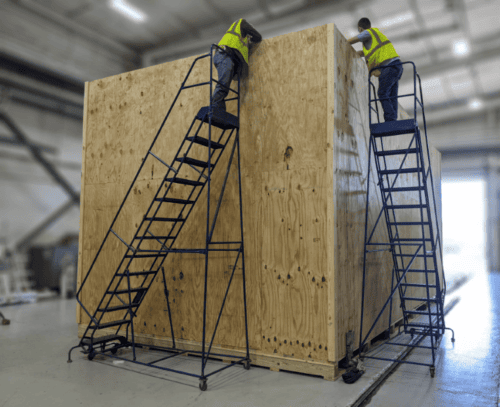
An industrial manufacturer needed to ship a piece of equipment weighing over 65,000 lbs. and measuring about 25′ long, 13′ wide, and 13′ tall. The crate needed to be shipped internationally with export-certified lumber. Due to the size of the equipment and crate, all work needed to happen at the customer’s facility.
Solution:
All lumber and plywood was precut at our facility and then transported to the customer. Due to the weight, length, and width of the equipment, a lumber only base would not suffice. Therefore we inserted steel tubing into the base for extra strength. The machine was then bolted to the steel to prevent any shifting. The steel tubing was also used to handle the finished crate using slings. The base, sides, ends, and top were all assembled at the customer’s facility and then raised and positioned using forklifts, straps, clamps, and cranes. In our experience, crates of this size are more likely to experience an impact on the sides during transport from things like trees hanging into the road. Therefore, we doubled up the lumber studs for extra strength and support if that happened.
Large Slat Crates to Reduce Cost and Weight
Challenge:
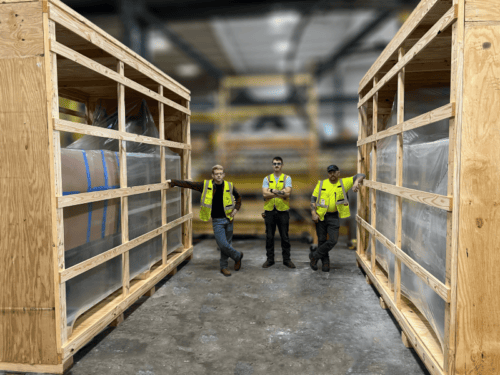
When shipping oversized equipment across the world, every inch and pound can make a big difference is cost. This manufacturer needed to ship multiple military units and was looking for a way to save on the shipping and crating cost, while still protecting their equipment. All lumber needed to be export-certified and the machines needed to be secured and wrapped to protect from the elements.
Solution:
Using all export-certified lumber, we designed custom slat crates which use significantly less material on the sides. Swapping full plywood sheets for 1×4 slats gives the crate structure and strength while cutting the weight of the sides by more than 50%. The ends of the crate remained fully sheathed with plywood to protect the equipment from wind during transport. The machines were then bolted to the base to prevent any movement. Sensitive areas of the equipment were then protected with cardboard or foam and then the entire machine was wrapped in plastic sheeting.
What We Engineer Into The Crate
We do more than fabricate a box. We take your input about the equipment specifications such as sensitive areas, center of mass, weight, and pick points and combine it with our knowledge about how it will be handled in transport like being picked up using a sling at the port or exposure to moist and salty air during ocean transport. This allows us to ensure the packaging will protect the equipment and everyone involved in handling it.
Support points
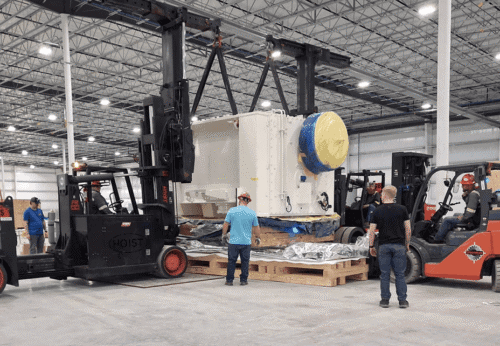
We identify where the system should be supported and where it should not. Support locations are chosen to follow the structure of the equipment and avoid overloading weak areas, skins, covers, or protruding features.
Blocking
Blocking is used to restrict movement around the base of the equipment. In custom crates, this usually involves boxing in the object on all sides with 4×6 lumber and securing that lumber to the crate base. Foam can also be used to help with non-flat surfaces, asymmetry, and fragile surface finishes.
Bracing
Bracing adds stability higher up on the equipment where swaying on a boat or turning a truck might become a problem. This is especially important for tall, irregular, or top-heavy assemblies that can shift or rock if they are not properly controlled.
Restraint design
Restraints are used as further protection to prevent equipment from moving or leaning side to side or up and down. These are engineered to hold the system securely without creating harmful point loads. Examples of this are metal banding, ratchet straps, and bolting the equipment to the base.
Surface protection
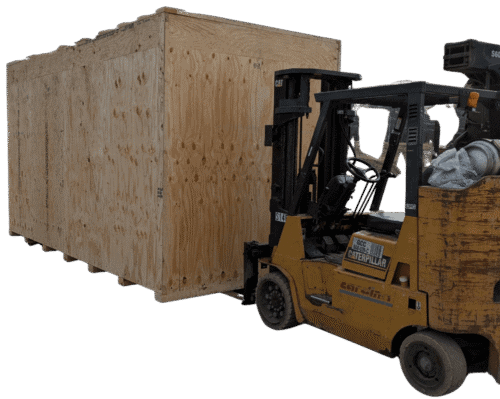
For systems with delicate finishes, sensitive protrusions, exposed antennas, painted surfaces, or cosmetic requirements, we design protective interfaces and no-contact zones to reduce abrasion, impact risk, and handling damage. If contact is unavoidable, we use foam, cardboard, or other soft materials to prevent any damage.
Transport stability
A large system needs a stable load path during shipment. Our crates are designed so that the equipment is supported with lumber from the base to the ground. We ensure the equipment weight does not put pressure on any wood spans or unsupported areas. In addition, we always aim to get the center of mass of the equipment centered in the crate so that handlers are not surprised when picking up the crate. This ensures the equipment remains supported during truck transport, loading, unloading, staging, and repeated handling events.
Practical handling features
Transport packaging also has to work in the real world. We incorporate loading and unloading practicality with features such as 4-way forklift access, lift planning, removable panels, pack/unpack access, orientation markings, inspection windows, and robust outer construction.
Quick-Turn Support For Prototypes and One-Off Packaging
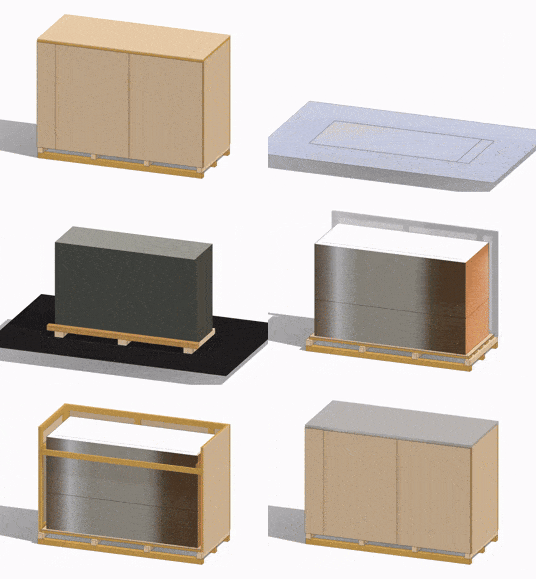
Prototype timelines are often compressed. We support quick-turn crate solutions for prototypes when a large system needs to move on a short schedule for testing, demonstration, integration, or field use. Whether you are a defense startup building a new autonomous aerospace system or an established manufacturer testing a new product line, we are able to design a custom crate and have it built in 2 weeks or less if needed.
Due to their size, oversized equipment is usually not manufactured in large quantities. Most commonly, our customers may make one unit every month or a small batch one time. In those cases, we can develop one-off engineered packaging that protects a unique system with custom supports, blocking, bracing, and restraint.
Whether it’s a prototype, one-off, or small run, we retain all packaging design and documentation so we can build the exact same packaging again in the future if needed.
Why Companies Use Vol Case for Large Equipment Packaging
-
Experience with industrial and military equipment weighing up to 70,000 lbs.
- ITAR registered, CMMC Level 2 – self assessed, DFARS & Berry compliance support, and secure CUI handling
-
Extensive experience with manufacturers, defense contractors, aerospace industry, and startups
- Ability to securely handle sensitive information
-
In-house 3D modeling and design capabilities
- 5 day turnaround times when needed
-
Past performance scaling from prototype to large production runs (100+ units)
- Fully customizable products manufactured with precision cutting machinery allowing for consistency across production runs
-
All products are USA made and sourced
-
Customer support that is proactive instead of reactive and same day response times
Repeatable Packaging For Multiple Builds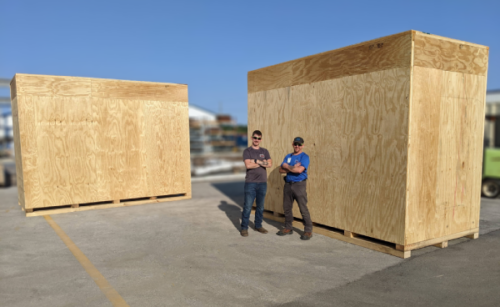
When the program moves beyond a single unit, we can also develop repeatable transport packaging for multiple builds. That includes packaging designs that can be documented, reproduced, and standardized so each build is packed the same way with predictable protection and handling.
This matters when you need a packaging design that works not just once, but across multiple shipments, multiple units, or multiple phases of a program. If a change is ever needed to the packaging, we create a new revision and retain the old packaging information as well. This allows us to easily track what changed and go back to the previous design if needed.
What We Provide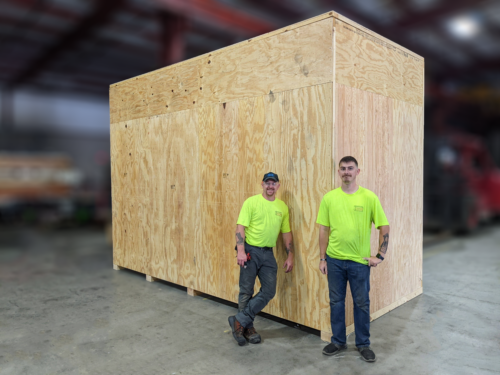
-
Custom wood crates
- Large transport cases
-
Oversized skids and bases
- Secure blocking and bracing
-
Bolted / restraint packaging
- Foam, cardboard, and surface protection
-
Ramps, removable panels, inspection windows, and access features
- Export-certified lumber
-
Waterproof barrier bagging and desiccant
-
On-site crating
- Serialized crates and packing documentation
-
Repeatable crate designs for multiple builds
Representative Example Projects
Below are examples of recent crating jobs that we completed:
60,000 lbs. Die Molding Machine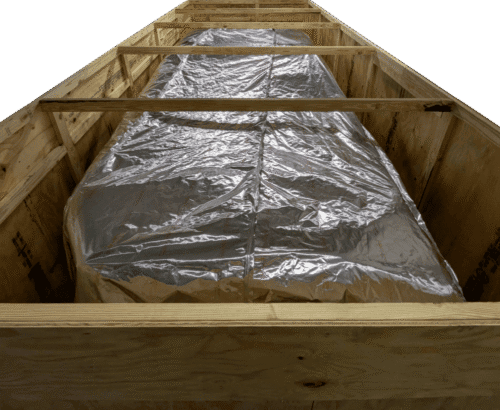
An auto manufacturer needed to ship a 16′ long, 60,000 lbs. die molding machine from Tennessee to Japan. In addition, the equipment had sensitive electrical components so the entire machine needed to be sealed in waterproof barrier bagging with desiccant inside. Complicating things were that the machine did not have any easily accessible bolting holes to secure the machine to the base. Ultimately, we were able to use several flanges on the machine base to sandwich those parts of the machine between the base and additional wood that was secured to the base. For extra support, we added blocking around all four sides with additional blocking in the front and back because that’s where the majority of force would be felt if the truck had to slam its brakes in transit.
Oversized Crate with Ramp for Tradeshow
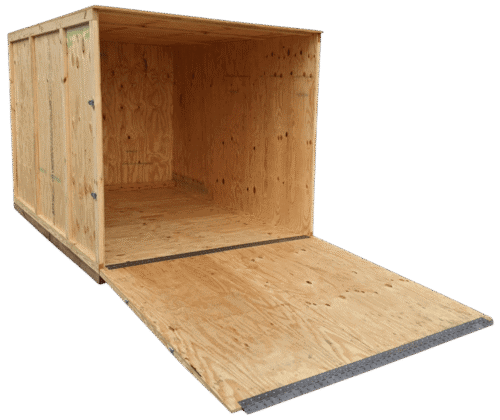
A boat manufacturer needed a crate to transport tradeshow items around the country. These were large portions of the boat, despite being fairly light for their size. The primary complication was that they wanted a ramp so they could easily roll the equipment in and out of the crate. We were able to design an 8′ x 8′ ramp by seaming together two plywood sheets using lumber that also acted as a support. The ramp also had supports under it so the ramp could rest on the ground instead of bowing and supporting the weight over an 8′ span. The ramp supports were positioned where the wheels would contact the ramp. Lastly, a larger metal hinge was added on the end of the ramp for a smooth and strong ramp tip that could fold away when closed. Latches were also added to keep the ramp secure in transit.
Consumer Manufacturer Relocating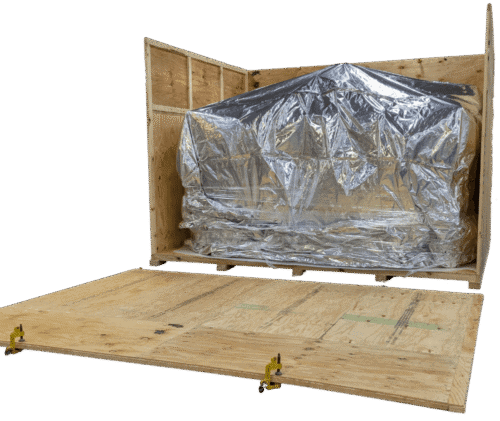
A manufacturer of consumer electronics was relocating from Tennessee to South Carolina and had 20 large machines that needed to be transported. Despite the short distance, the sensitive nature of their equipment required them to have everything sealed in waterproof barrier bagging with desiccant and fully crated. All lumber and plywood was cut at our facility. Smaller crate components were then built at our facility built as well and transported to the customer. Larger assembly and final crating was done at the customer’s location. All equipment was secured to the base of the crate using large screws or bolts. The blocking was added on all four sides to prevent any sliding. Finally, banding was used to hold machinery down or hold together multiple items.
22 Large Crates
Our customer needed to ship an entire line of manufacturing equipment to Europe by the end of the year. We were notified about the job in November, quickly went onsite to evaluate the machinery, gave them a quote, and started working in early December.
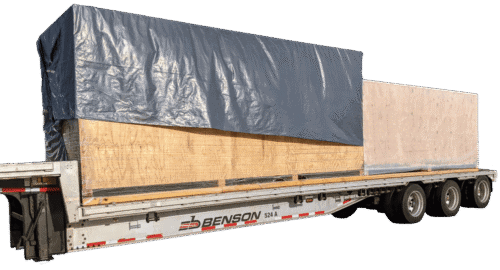
We were able to manage a tight timeline and coordinate with the millwrights and trucking company to ensure everything got out on time. We built 8 unique crate styles across the 22 pieces of equipment for a total of 238,000 lbs. and the largest crate being 20′ long, 12′ wide, and 12′ tall. All crates were wrapped in waterproof barrier bagging with desiccant. In addition, we had to work around the weather because the majority of the work had to happen outside the facility to prevent any wood dust from contaminating the facility.
Our Approach
 1. Review the equipment
We start with the equipment’s size, weight, geometry, support requirements, and sensitive areas. We then determine how the equipment and packaging will be shipped to identify additional packaging requirements. We have full 3D design capabilities, so we can work off your 3D models, drawings, or photos of each item.
2. Design the custom crate
We determine whether each component should have its own dedicated crate or if they can be combined into fewer crates. This depends on how each component should sit for protection, access, and inspection. Once the general layout is determined, we select the thickness of wood to be used on the crate base which is based on the weight and securing method of the equipment. Finally, we design any blocking, bracing, and restraints needed.
3. Customer review
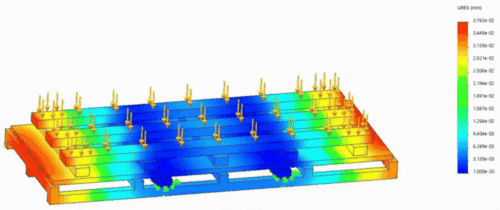
Once the crate is designed, we send you a link for review and approval. We can make any changes at this point or put the design through testing such as FEA analysis.
4. Build the first crate
If the crate is something that we will build multiple times, we may just build one, confirm everything goes smoothly, and then build the remaining units. If the project is a one-off run, then we would build the first and final unit.
5. Repeat the packaging when needed
Regardless of whether the packaging is a one-off, prototype, or multi-unit build, we retain the 3D models, machine code, and production packets so the packaging can be repeated later. This supports a smoother transition from one urgent prototype to a repeatable product presentation and transport solution.
The result is a transport-ready design built for the realities of shipment, handling, and field use, not just storage.
Frequently Asked Questions
What if the system is too big for standard packaging or a hard case?
That is exactly where engineered transport packaging becomes necessary. When equipment is too large for a standard hard case, we design a custom crate or large transport package around the actual dimensions, support points, and handling needs of the system.
Can you design a crate for awkward geometry?
Yes. Many large prototypes and technical systems have unusual shapes, unstable resting surfaces, protrusions, or asymmetrical weight distribution. We design support for awkward geometry using custom blocking, bracing, restraint, and protected clearances.
How do you protect delicate surfaces during transit?
We identify sensitive finishes, exposed features, and contact limitations early in the design. Then we engineer the support method so loads are carried through appropriate support points while delicate surfaces and protrusions are shielded from abrasion, impact, and harmful contact.
Do you only build crates, or do you design the internal support too?
We design the full transport solution. That includes the internal support method, restraint, blocking, bracing, surface protection, and the outer packaging needed to make the shipment practical and robust.
Can the same crate design be repeated for multiple builds?
Yes. When the same or similar system will ship more than once, we can develop repeatable large-system packaging that can be documented and used across multiple builds for more consistent protection and packout.
Can you support one-off prototype timelines?
Yes. We support large prototype transport and quick-turn packaging needs when a program requires an engineered solution on a compressed schedule.
What kinds of systems are a good fit for this?
This approach is a strong fit for large drones, robotic systems, aircraft prototypes, antenna systems, oversized technical assemblies, and other equipment that is too large for a standard hard case or too delicate for generic crating.
Request a Quote for Large Custom Crating
Have a large prototype or oversized system that needs a custom crate?
We can help develop a custom crate, large transport case, or full oversized equipment packaging solution with the support points, blocking, bracing, restraint, and handling features needed to move the system safely and practically.
About Vol Case
Vol Case & Container is the oldest custom crate and case manufacturer in the East TN area. Founded over 30 years ago, all of our protective packaging solutions are still designed and assembled at our facility in Oak Ridge, TN. We specialize in custom wood crates, ATA cases, wood or plastic containers, injection molded cases, and waterjet or CNC cut foam inserts. Our customers span a variety of industries including nuclear, government, aerospace, military, medical, R&D, and more. Our team has experience designing and building everything from huge wood crating for 70,000+ lbs machinery to small injection molded cases for key-sized objects. Whatever your needs, our team works on quick turnaround times to provide you with high quality protective packaging. Contact us today for a free quote.
Contact Us
Whether you need one wood crate or hundreds of injection molded cases, we’d love the chance to earn your business. All of our designs and quotes are done for free without any purchase required. We are able to work off dimensions/CAD files that you provide to us or we can visit your facility to take measurements of the equipment.
(865) 481-3801
sales@volcase.com
328 Warehouse Rd. Oak Ridge, TN 37830