Case Study: Custom Antenna Kit Transport Cases with Organized Foam Pack-Outs
Read the case study
- Units produced
- 140
- Components
- 16
- Prototypes
- 2
On this page
Executive Summary
Due to the confidential nature of this program, some technical details, product views, and identifying information have been intentionally withheld, limited, or modified. The information and images included in this case study are presented in a way that preserves the accuracy of the packaging solution while protecting sensitive aspects of the underlying equipment.
A defense communications equipment supplier contacted Vol Case after receiving an urgent order for military field antenna kits. The customer needed 30 completed transport cases ahead of a fixed delivery deadline, but reported that its existing packaging supplier was quoting a 6–8-week lead time.
The project required an organized hard-case pack-out for antennas, a mast, stakes, cables, tools, and accessories. The customer already had an established layout, so our work focused on preserving that arrangement while correcting fitment problems, improving foam construction, and making equipment easier to remove.
We reconstructed the design from an existing case, developed two foam prototypes, coordinated customer fitment approval, and delivered all 30 cases 21 calendar days after first contact.
Approximately three months later, the customer ordered another 60 cases followed by another order of 50 two months after that. The repeat order used the same approved design and was completed within one month of the purchase order, without requiring the customer to resend equipment or resolve additional design questions.
Project Snapshot

- Customer type: Defense communications equipment supplier
- Application: Field antenna / communications kit for military use
- Case platform: SKB 3i-2918-14BE
- Foam used: CNC-machined 2 lb cross-linked polyethylene (XLPE) in the lid and base
- Number of components: 16 equipment/accessory line items across 11 storage positions, including three in the lid
- Retention and backing: 1-inch hook-and-loop straps; ¼-inch ABS manual backing plate
- Design inputs: Photographs and an existing case with foam
- Physical prototypes: Two
- Initial production: 30 cases delivered 21 calendar days after first contact
- Repeat production: 110 cases, unchanged design, completed within one month of PO
- Intended use: Repeated deployment and repacking; vehicle, ocean, freight, air, and manual transport
The Challenge

The customer needed finished packaging in time to load its equipment and meet a military delivery commitment. That meant the schedule had to cover the entire project: supplier onboarding, design reconstruction, material procurement, prototyping, customer approval, production, and transportation.
An existing case and foam layout provided a starting point, but usable CAD files were not immediately available. After two days of trying to obtain them, we arranged for the customer to overnight an existing case to our facility so we could work directly from the physical sample.
The sample also revealed problems that should not simply be reproduced. A poorly fitting bottom pad raised the mast into the lid foam, creating unwanted pressure and making the case harder to close. Elsewhere, separate foam support strips allowed the main insert to sit inconsistently in the base.
The requirement was therefore more specific than copying an old foam set. We needed to retain the familiar component locations and specified materials while improving how the insert fit the case, supported the equipment, and went together in production.
The Packaging Solution: An Organized Field Antenna Kit

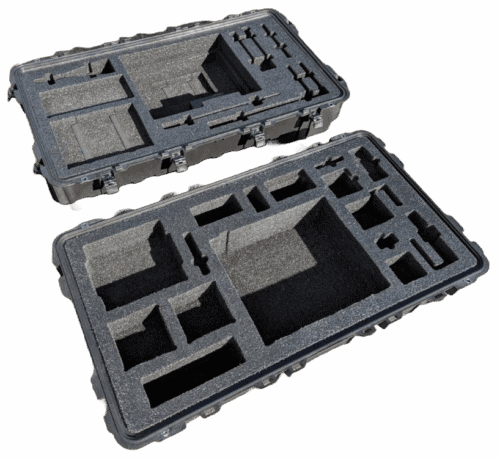
We built the packaging system around the customer’s existing SKB 3i-2918-14BE case platform. Both the lid and base used CNC-machined 2 lb XLPE, matching the foam specification already established for the kit.
The pack-out accommodated antennas, a mast, stakes, hand tools, a hammer, cables, and an accessory bag. Antennas occupied shaped pockets in the lid, while the base held the mast, stakes, tools, and other accessories. A separate lid arrangement provided removable storage for the manual.
Across the case, 11 defined storage positions organized the equipment and grouped accessories. Three of those positions were in the lid. This was not a one-pocket-per-piece layout; some positions accommodated related items together.
We kept those locations consistent with the previous case. The goal was to improve the execution of an established pack-out, not introduce a new arrangement that operators would have to learn.
For a kit intended to be deployed and repacked repeatedly, that consistency mattered. The layout continued to provide a known location for each item or group, while the revised foam addressed the fit and access problems within those locations.
Fitment and Support Improvements

Correcting mast clearance around the wheel wells
The original rubber pad did not accommodate the wheel wells correctly. As the pad distorted around the case geometry, it raised the mast above its intended position. The mast then pressed into the lid foam, leaving deep impressions and making closure more difficult.
The customer had not reported equipment damage from this interference, but the unwanted pressure was a problem they wanted resolved.
We replaced the rubber pad with a fitted XLPE pad cut around the wheel wells. Because the replacement could sit correctly in the base, the mast rested approximately ¼ inch lower while retaining the same padding thickness underneath.
The improvement came from fitting the support to the case geometry, not removing padding to create more clearance. During the customer’s physical fit-check, they confirmed that the previous lid interference had been resolved.
Replacing separate support strips with a fitted bottom layer
A separate issue involved the telescoping-handle housing, which created an uneven interior surface in the case base.
The previous foam construction used two strips beneath the main insert to compensate for that geometry. This left the main foam dependent on separate support pieces and allowed it to sit somewhat loosely and inconsistently.
We instead cut the bottom support layer as one solid piece fitted to the case walls. We then flipped the piece over and CNC-machined an underside relief groove around the telescoping-handle housing. That allowed the support layer to sit more consistently in the base without relying on separate strips beneath it.
The finished foam was secured to the case with adhesive. Together, the fitted perimeter, underside relief, and bonded installation established a more consistent seated position for the insert.
Lid Retention and Equipment Access

Antenna pockets with wraparound strapping
The antennas had dedicated pockets in the lid foam, with 1-inch hook-and-loop straps providing retention.
The straps wrapped around the full lid foam set, passing behind the insert and returning across the equipment positions. This arrangement held the antennas in their pockets while allowing the straps to be opened for removal and closed again after repacking.
The pocket geometry and strapping served different functions: the foam established where the antennas belonged, while the straps retained them in the lid.
A firm attachment surface for the manual
A separate lid pocket held a ¼-inch ABS plate glued into place. The plate provided a smooth, firm surface for the hook-and-loop material used to attach the manual. This allowed the manual to be removed when needed and secured back into the lid afterward.
Finger access and pocket-fit adjustments
We also added finger-access cutouts and made small pocket-fit adjustments to improve equipment removal.
These changes preserved the original storage locations while providing better access around the parts. For a repeatedly packed field kit, the insert needed to do more than hold the equipment at rest. It also needed to allow operators to take items out and return them without struggling against an unnecessarily tight pocket or limited hand clearance.
Prototyping and Fitment Verification
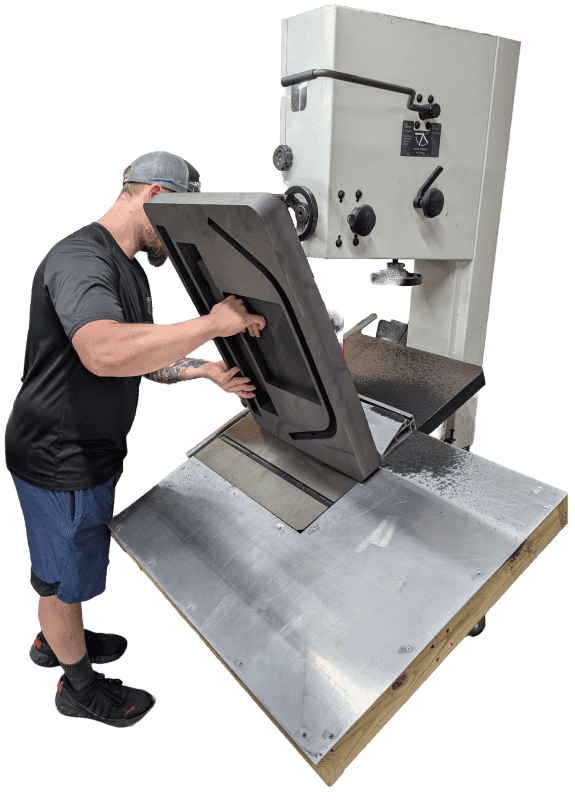
We completed two foam prototypes within a 48-hour window. The first build was used internally to evaluate how the foam should be cut, layered, and assembled. The second incorporated manufacturing refinements and was shipped to the customer for equipment fitment.
One refinement involved changing the layer-thickness divisions to make assembly easier and improve the finished appearance. A bottom pad that used three pieces in our first prototype was changed to a single solid piece in the revised build. This was a construction improvement within the same overall kit layout.
Internal quality checks included measuring the machined pockets against the design, assessing the sturdiness of the foam set, checking case closure and strap retention, and reviewing overall assembly quality.
We did not have the actual kit components at our facility. Our dimensional and assembly checks were therefore followed by a physical equipment fit-check at the customer’s location. We sent measurements and photographs during development, then overnight-shipped the second prototype for that review.
The customer’s fit-check confirmed the equipment fit and the mast-clearance correction. Verification for this project covered dimensions, assembly, and customer-confirmed fitment; third-party drop, vibration, and transport testing were not part of the project.
Turnaround and Collaboration

Design, sourcing, and supplier onboarding
We provided a preliminary estimate the same day the customer sent photographs. Once the sample case arrived, we reconstructed the foam in 3D and supplied a design and formal quote within 24 hours.
While the customer reviewed that information, we worked in parallel on material sourcing and expedited shipping. When our usual case supplier could not support the schedule, we located an alternate source that could express-ship the required cases.
Within five business days, we had completed the vendor setup paperwork, reconstructed and improved the design, submitted the quote, and ordered the materials needed for production.
Maintaining progress during the fit-check delay
The customer’s physical review was delayed by two days because a required kit component had to be shipped from another facility.
Rather than stop the entire project, we confirmed which portions of the packaging would remain unchanged. Production continued on those approved sections, including the lid, straps, plastic backing plates, and a smaller section of the base.
The remaining foam work followed the customer’s final fitment approval. This kept the project moving forward even while elements of the packaging remained undecided.
Production and delivery
We adjusted an already-busy production schedule and worked an extended shift to complete the cases in time for shipment.
The final constraint was transportation. Standard less-than-truckload freight could not guarantee the next-day arrival the project required, so we arranged a dedicated truck to travel directly from our facility to the customer.
The truck arrived the following morning. All 30 completed cases were at the customer’s facility one day before the required in-hand date, 21 calendar days after the initial inquiry.
Outcome

The customer confirmed that receiving the cases on time allowed it to pack the equipment and meet its military delivery deadline.
The project also resolved the specific fitment issue identified during design review. The mast sat lower without reducing the padding beneath it, and the customer’s fit-check confirmed that it no longer created the previous interference with the lid.
Meeting the initial delivery commitment led to a later contract for the same equipment at twice the original quantity and another order shortly behind that one. That follow-on work led to a total of 110 additional cases.
During the production of the 140 cases produced to date, no defects or quality issues had been reported to Vol Case.
Prototype-to-Repeatability
Approximately three months after the initial order, the customer ordered another 110 cases across two production runs. We completed both production runs within one month of the purchase order, with no changes to the approved packaging design. Across the three orders, the program reached 140 production cases and is still ongoing.
The repeat build did not require the customer to resend equipment, provide another sample case, or answer additional design questions.
We retained the CAD models, CNC programs, material specifications, strap lengths and installation locations, assembly instructions, inspection criteria, and complete production packets. Those records defined both the components to manufacture and how the finished foam set should be assembled and checked.
Strapping was also cut using our automatic strap cutter, allowing the approved lengths to be reproduced quickly and consistently across the production run.
The result was an established communications-kit pack-out that could be ordered again without restarting development. The equipment locations, foam geometry, retention arrangement, and assembly method remained consistent from the first production batch to the next.
Conclusion

This project combined an organized field-kit layout with targeted fitment improvements and a fixed delivery requirement. Vol Case preserved the customer’s established arrangement, corrected how the foam accommodated the case interior, verified equipment fitment with the customer, and delivered 30 completed cases before the deadline. The approved packaging system then carried directly into a 60-case and 50-case repeat order.
The same considerations apply to custom cases for drone, robot, and comms kits: defined equipment locations, practical access, support that fits both the equipment and the case, and production records that allow the approved pack-out to be reproduced across additional units.